On September 7, a Sri Lankan multi-party delegation visited Shanghai Administration Institute(SAI). Vice President Wang Yongjie hosted the meeting.
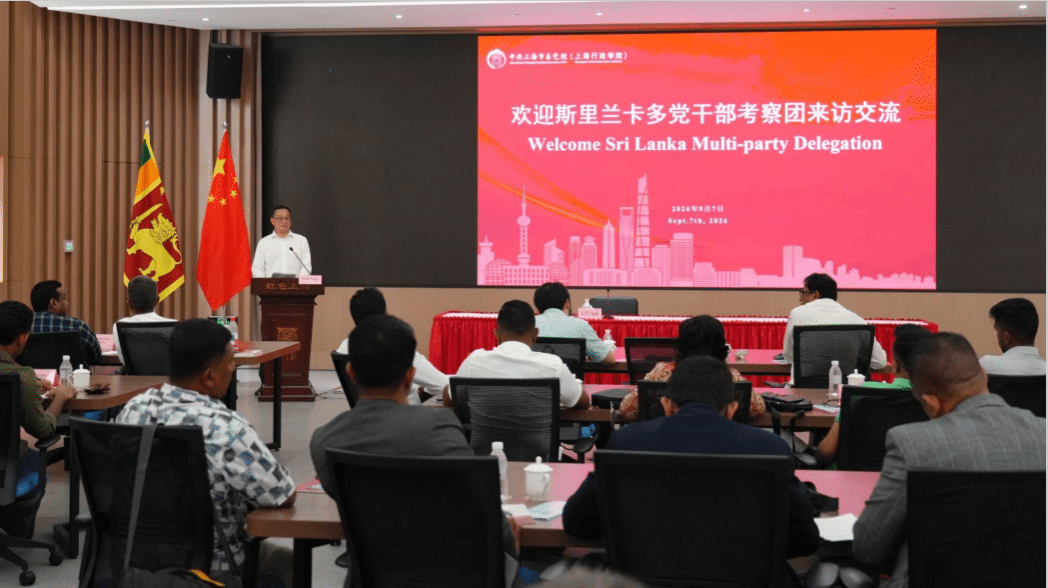
Vice President Wang Yongjie introduced the delegation to SAI’s basic activities in cadre education and training, international cooperation and other areas, and reviewed the history of academic exchanges between SAI and Sri Lanka. He noted that China and Sri Lanka enjoy a long-standing traditional friendship and expressed the hope that the exchange would further strengthen friendship between the two sides and lay a solid foundation for the delegation’s visit to China. He expressed the expectation that both sides would take this opportunity to continuously deepen exchanges and cooperation, learn from each other’s experiences, and make greater contributions to promoting exchanges on governance and state administration and building a China-Sri Lanka community with a shared future.
The delegation expressed its appreciation for the SAI’s warm reception and spoke highly of its efforts and achievements in serving the overall interests of the Party and the country’s foreign affairs and in developing an internationalized educational system. Representatives of the delegation spoke highly of the notable achievements made by the Communist Party of China (CPC) in strengthening Party self‑governance under the guidance of Xi Jinping’s Thought on Party Building. They noted that the CPC’s approaches, experience, and achievements in strengthening Party self‑governance provide useful reference for Sri Lanka in strengthening its political parties and promoting national development. The delegation expressed its hope that both sides would give full play to the role of young political leaders, continue to deepen bilateral relations, and pursue more in-depth and practical cooperation.
Professor Luo Junli, Deputy Director of Department of Party History and Building, delivered a thematic presentation entitled “How the Communist Party of China Strengthens Party Building in the New Era,” introducing the contemporary significance and core substance of Xi Jinping’s Thought on Party Building. The participants engaged in lively and substantive discussions, exchanging views on topics including full and rigorous Party self‑governance, Party conduct and clean government, investigation and research, the adaptation of Marxism to the Chinese context, and population aging.


 Shanghai public network filing 3101042008844.