From April 22 to 24, a delegation led by Yook Dong-il, President of the Korea Research Institute for Local Administration, visited Shanghai Administration Institute(SAI) and jointly hosted the China–ROK bilateral seminar on “Urban Governance Based on Artificial Intelligence and Digital Technologies.” Prior to the seminar, Vice Presidents Luo Feng and Wang Yongjie met with the visiting delegation.
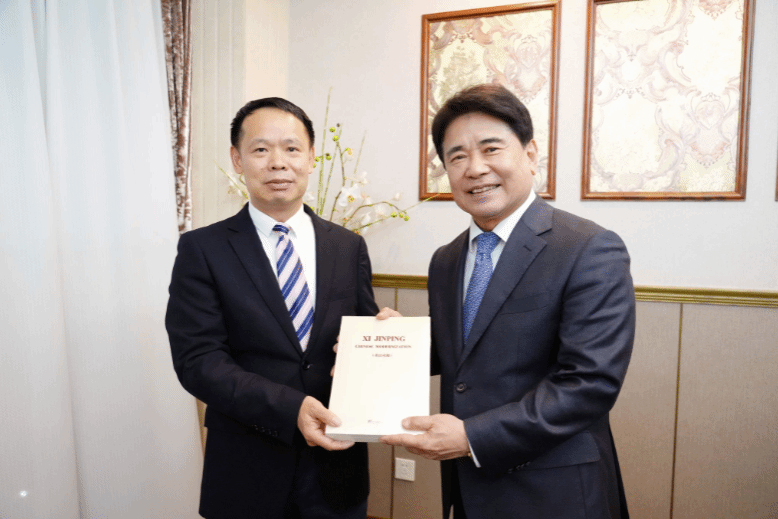
Luo Feng extended a warm welcome to the delegation and introduced recent developments of SAI, including institutional reforms and talent recruitment initiatives. He also reviewed exchanges between the two sides since the renewal of their memorandum of cooperation. Quoting President Xi Jinping’s important remarks during this year’s meeting between Chinese and Korean leaders, Luo noted that, as friends and neighbors, China and the ROK should maintain frequent visits, exchanges, and communication. He added that Shanghai is currently making every effort to implement the 15th Five-Year Plan, enhance the capacity of the “Five Centers,” and accelerate modernization and high-quality development. He expressed hope that the two institutes would deepen cooperation and jointly serve the consensus reached by the leaders of both countries as well as local development needs.
Yook Dong-il expressed gratitude for the warm reception. He noted that over the past 25 years since the establishment of cooperative relations, the two institutes have achieved fruitful joint research outcomes. He spoke highly of the great practice of Xi Jinping Thought on Socialism with Chinese Characteristics for a New Era, stating that the Communist Party of China’s overall leadership, the people-centered development philosophy, and the socialist market economy system provide fundamental guarantees for China’s development and stability. He also fully affirmed Shanghai’s leading and exemplary role in China’s path to modernization. He expressed the hope that both sides would continue to work together to contribute wisdom to China–ROK exchanges and cooperation as well as innovation in local governance.
The two sides also conducted in-depth discussions on topics including coordinated regional development, the building of a people-centered city, and the empowerment of artificial intelligence.
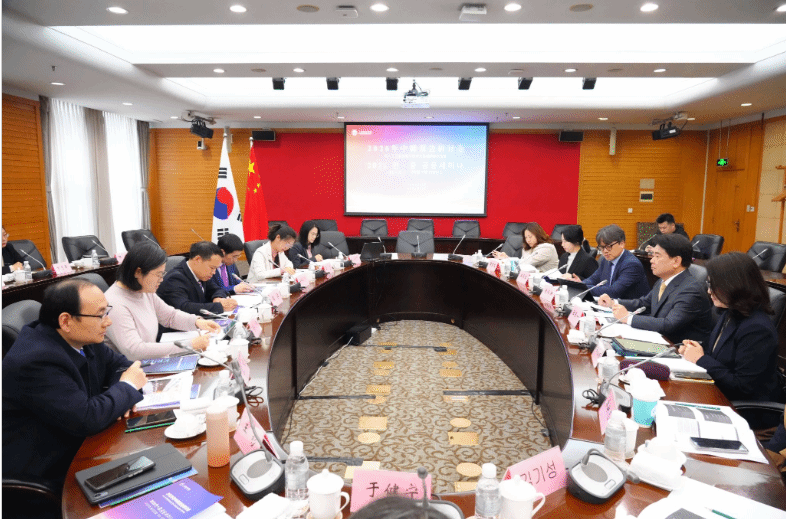
On April 23, the seminar on “Urban Governance Based on Artificial Intelligence and Digital Technologies” was held. In his opening remarks, Luo Feng pointed out that artificial intelligence and digital technologies are entering a phase of rapid development, offering significant opportunities to optimize the governance systems of megacities and alleviate “urban diseases.” He emphasized that AI and digital technologies are not only governance tools but also key driving forces for reshaping urban values and promoting multi-stakeholder collaboration. In addressing the three core relationships—development and security, efficiency and equity, and order and vitality—he stressed the importance of adhering to a people-centered approach and ensuring that technology is used for good, so that the benefits of digital governance can be shared by cities and citizens worldwide.
Drawing on Korea’s experience, Yook Dong-il noted that artificial intelligence and digital technologies have profoundly transformed policymaking, public services, and the relationship between governments and residents. He highlighted that the core challenge for local governments lies in building governance systems that are precise, transparent, accountable, and trust-based. He also expressed the hope that mutual learning between China and the ROK would help explore new paradigms for urban governance in East Asia.
During the thematic presentation session, Director Ju Hee-jin of the Korea Research Institute for Local Administration, based on Korea’s practical experience, pointed out that in the era of AI transformation, local governments are no longer merely policy implementers but are evolving into core data-driven decision-making entities. Associate Research Fellow Hwang Joung-yoon analyzed, with detailed data, the opportunities and challenges brought by AI empowerment to local governments. From the Shanghai Development Research Center, Research Fellow Zhang Feng, drawing on innovative practices in the digital governance of Shanghai as a megacity, summarized a new paradigm of “digital governance” for megacities. Assistant Research Fellow Li Xiaojing used the case of “Shutong Chain Valley” to outline typical practices of blockchain empowering new quality productive forces in Shanghai.
Both sides agreed that artificial intelligence and digital technologies are accelerating the transformation of policy research toward practical application. Looking ahead, they will continue to deepen joint research and mutual learning around topics such as innovation in megacity governance and improvement of residents’ quality of life. They also aim to strengthen cooperation in areas including local governance, smart cities, and coordinated regional development, working together to contribute Eastern wisdom to global development.





 Shanghai public network filing 3101042008844.