To thoroughly study and implement the guiding principles of the Third Plenary Session of the 20th CPC Central Committee, promote the integration of the guiding principles of the Third Plenary Session of the 20th CPC Central Committee into teaching materials, classrooms, and thinking, and improve teachers’ ability and level of comprehensively, accurately, and thoroughly explaining the guiding principles of the Plenary Session, the Shanghai Party Institute of CPC (hereinafter referred to as “SPI”) organized a special teacher training course for Shanghai’s party school system from August 12 to 13. Zeng Jun, Executive Vice President of SPI, took part in discussions and made a training summary. DAI Bing and LUO Feng, Vice Presidents of SPI, ZHAO Yong, Director of the Division of Teaching Management, and LI Meng, Director of the Division of Scientific Research Management, presided over such discussions respectively. This teacher training showed six characteristics as follows.
First, we organized the training to act on the guiding principles of the Third Plenary Session of the 20th CPC Central Committee at the earliest opportunity. We promptly held study symposiums, developed a series of courses, wrote theoretical articles, researched countermeasures, and organized teaching and research departments to conscientiously study and fully discuss the guiding principles of the Plenary Session. On such basis, a special teacher training course was held for the city-wide Party school system to thoroughly study a series of new ideas, viewpoints, and conclusions proposed by General Secretary Xi Jinping on deepening reform in an all-round way and to deeply understand the great significance, overarching themes, key principles, major measures, and fundamental guarantees for further comprehensively deepening reform.
Second, faithfully learning was primarily required for this training. The Communique of the Third Plenary Session of the 20th Central Committee of the Communist Party of China, the Resolution of the Central Committee of the Communist Party of China on Further Deepening Reform Comprehensively to Advance Chinese Modernization, and General Secretary Xi Jinping’s explanation of the Resolution of the Central Committee of the Communist Party of China on Further Deepening Reform Comprehensively to Advance Chinese Modernization, as well as the guidance materials distributed by relevant departments were studied part by part, paragraph by paragraph, and line by line in this training workshop to fully, accurately, and comprehensively understand the rich connotations and core elements of the guiding principles of the Plenary Session.
Third, the entire training process was discussion-oriented. Solid theoretical support was provided by delivering keynote speeches for discussion-based teaching and conducting interactive exchanges for discussion-based learning. Such keynote speeches focused on sorting out, constructing, summarizing, and improving the collective lesson preparation results of the teaching and research departments. The interactive exchanges developed new ideas and methods for resolving problems in teaching and scientific research with doubts being answered and exchanges being commented on by experts.
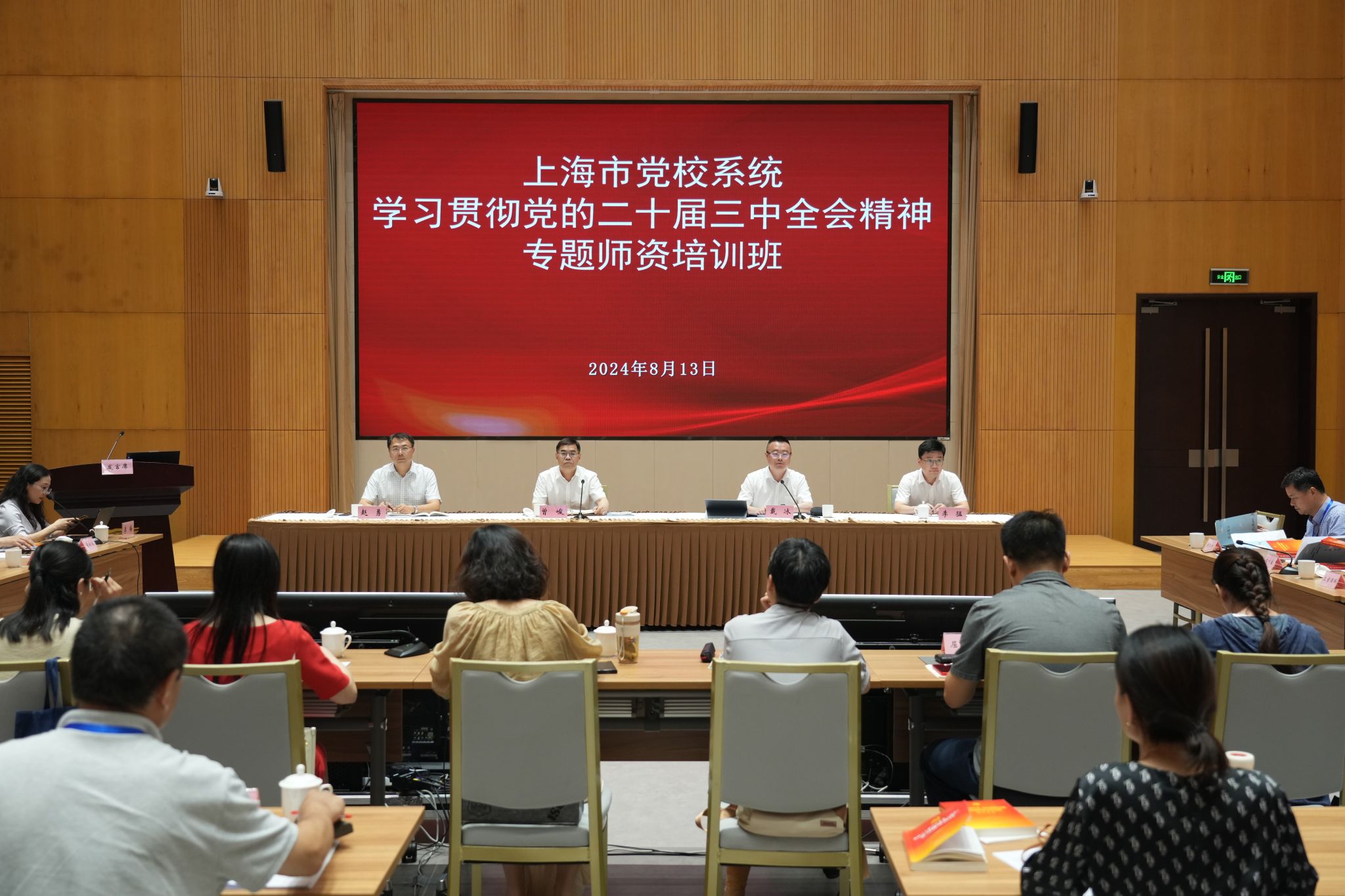
Fourth, teaching, research, consultation, and communication were implemented in an integrated manner. This training is both a collective lesson preparation meeting for Shanghai’s Party school system and a teacher training program for theoretical public communication. Besides, it is an in-depth academic seminar and has incubated and cultivated teaching and research results. It is an innovative practice to jointly promote the building of courses for officials training, the research of the Party’s innovative theories, the guidance of theoretical article writing, and the training of teaching staff capabilities.
Fifth, the effectiveness of this teacher training was improved through coordination in all directions. Teachers and researchers from SPI and the Party schools jointly studied. Experts and scholars from the Party school system and other institutions jointly discussed, and teaching and research departments and research institutes jointly prepared lessons “across disciplines.” The Division of Teaching Management, Division of Scientific Research Management, and Personnel Division, Working Office for District Party Schools, Teachers’ Continuing Education College, and other “cross-departmental” departments were jointly organized.
Sixth, the training results have been expanded for the long tail effect. Shanghai’s Party school system will take this training as an opportunity to incorporate the guiding principles of the Third Plenary Session of the 20th CPC Central Committee into the teaching plan, update teaching content in a timely manner, and develop new courses; focus on the major conclusions, important arrangements, and vital requirements put forward at the Plenary Session to conduct theoretical research, carry out research on countermeasures, write and publish theoretical articles, and apply for scientific research projects; make good use of student resources to carry out publicity and promotion and decision-making consultation. The system will also identify correct entry points and combing points in line with the plans and requirements of the Third Plenary Session of the 20th CPC Central Committee and the Fifth Plenary Session of the 12th CPC Shanghai Municipal Committee, item by item, and truly transform the guiding principles of the Plenary Session into practical actions and work results.
Teachers from the Party school system who participated in this training all said that this training was timely given in a novel form. Not only was the theme comprehensive, systematic and in-depth, but the discussion was also theoretically advanced and practically profound. The participants expressed that they deepened their understanding and grasp of the guiding principles of the Third Plenary Session of the 20th CPC Central Committee after this training, which was of great reference value and significance for carrying out the training and dissemination of the guiding principles of the Plenary Session and for thoroughly explaining ideas, making theories alive, and telling vivid stories.


 Shanghai public network filing 3101042008844.