In order to celebrate the successful opening of the 20th National Congress of the CPC and better understand and implement XI Jinping Thought on Socialism with Chinese Characteristics for a New Era, on July 10, the Shanghai Academy of Social Sciences, the Shanghai Institutes for International Studies, the Shanghai Federation of Social Science Associations, and the Shanghai Party Institute of CPC co-held the Seminar on XI }inping Thought on Socialism with Chinese Characteristics for a New Era: Theory and Practice. The Shanghai Party Institute of CPC hosted solely Parallel sub-forum IV: Party Leadership and State Governance. At the forum, revolving around “the institutional development of the Party’s leadership system and state governance” and “the institutional development of the state governance system and governance effectiveness”, ten experts explained, from the logical perspectives of theory, practice, institutions, politics, and subject, “why the Party’s leadership is the most essential feature of socialism with Chinese characteristics and the greatest institutional advantage of socialism with Chinese characteristics”.
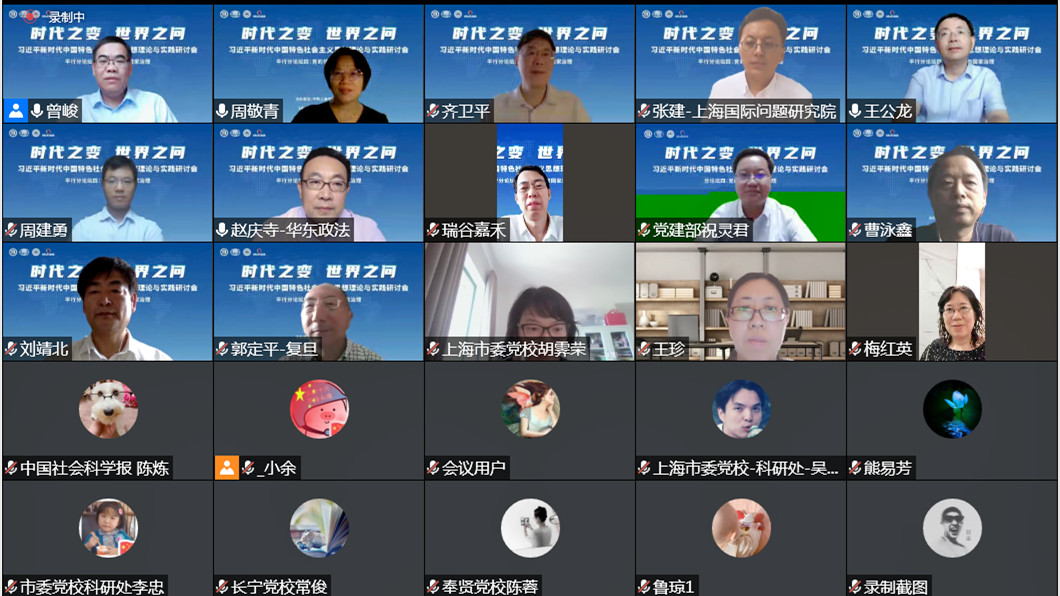
Professor ZHU Lingjun, deputy director of the Party Building Teaching and Research Department of the Party School of the Central Committee of CPC, elaborated on the key points of the Party’s leadership and proposed essentialist understanding of the proposition that “the most essential feature of socialism with Chinese characteristics is the leadership of the Chinese Communist Party”. Professor LIU Jingbei, vice president of the China Executive Leadership Academy, Pudong, explained General Secretary XI Jinping’s theory of upholding and strengthening the Party’s overall leadership from five aspects: inherent uniqueness, fundamental leadership, irreplaceability, inseparability, and decisiveness. Professor QI Weiping from East China Normal University analyzed the theoretical position of upholding the Party’s overall leadership in XI Jinping Thought on Socialism with Chinese Characteristics for a New Era, and its strategic position in China’s state governance. Professor WANG Gonglong, executive dean of the School of Marxism, Shanghai Party Institute of CPC, discussed the theoretical logic of ensuring the Party’s leadership for a new era and its original contribution from the perspectives of theory, system, politics, and subject. Professor ZHOU Jianyong from the Party Building Teaching and Research Department, Shanghai Party Institute of CPC, started with the Party’s overall leadership of the state governance system after the 18th National Congress of the CPC, summarized such ideas as the full integration of the Party and the government and further consolidation of the Party’s leadership, and analyzed the basic logic of the Party’s leadership of state governance for a new era. Professor JI Zhengju, deputy editor-in-chief of Economic Daily, summed up the significant experience of how the Party has led economic work in the new era by introducing the specific measures, concepts, and methods adopted, as well as the ability and quality of the CPC officials. Professor GUO Dingping from the School of International Relations and Public Affairs, Fudan University explored the new model of the CPC’s governance through the horizontal comparison of state governance models around the world and the vertical comparison of state governance changes in China. Professor CAO Yongxin, executive deputy editor-in-chief of the Studies on Mao Zedong and Deng Xiaoping Theories (Shanghai Academy of Social Sciences), focused on the theme of “changes of the times” and discussed the effects of three variables: environment, concept, and population, on future governance and governance capabilities. Professor ZHAO Qingsi, dean of the School of Marxism, East China University of Political Science and Law, believed in the necessity to unify political security, people’s safety, and national interests, and ensure national security based on the international order, the premise of preventing risks, and the major strategic opportunities for China’s development. ZHANG Jian, secretary-general of the Center for World Politics and Political Parties, Shanghai Institutes for International Studies, examined the institutional development and effectiveness of the Central Committee on Hong Kong affairs after the 18th National Congress of the CPC.
The experts present believed that since the 18th National Congress of the CPC, the Party’s leadership has been strengthened across the board, providing institutional guarantees for advancing and achieving the two centenary goals. The forum, which was moderated and commented on respectively by Professor ZENG Jun, vice president of the Shanghai Party Institute, and Professor ZHOU Jingqing from the Division of Scientific Research Management of the Shanghai Party Institute, provided Chinese wisdom and Chinese solutions to “the problems confronting an ever-changing world” through in-depth discussions on the relationship between the Party’s leadership and state governance. More than 90 teachers and graduate students from the Shanghai Party Institute attended the forum online.


 Shanghai public network filing 3101042008844.