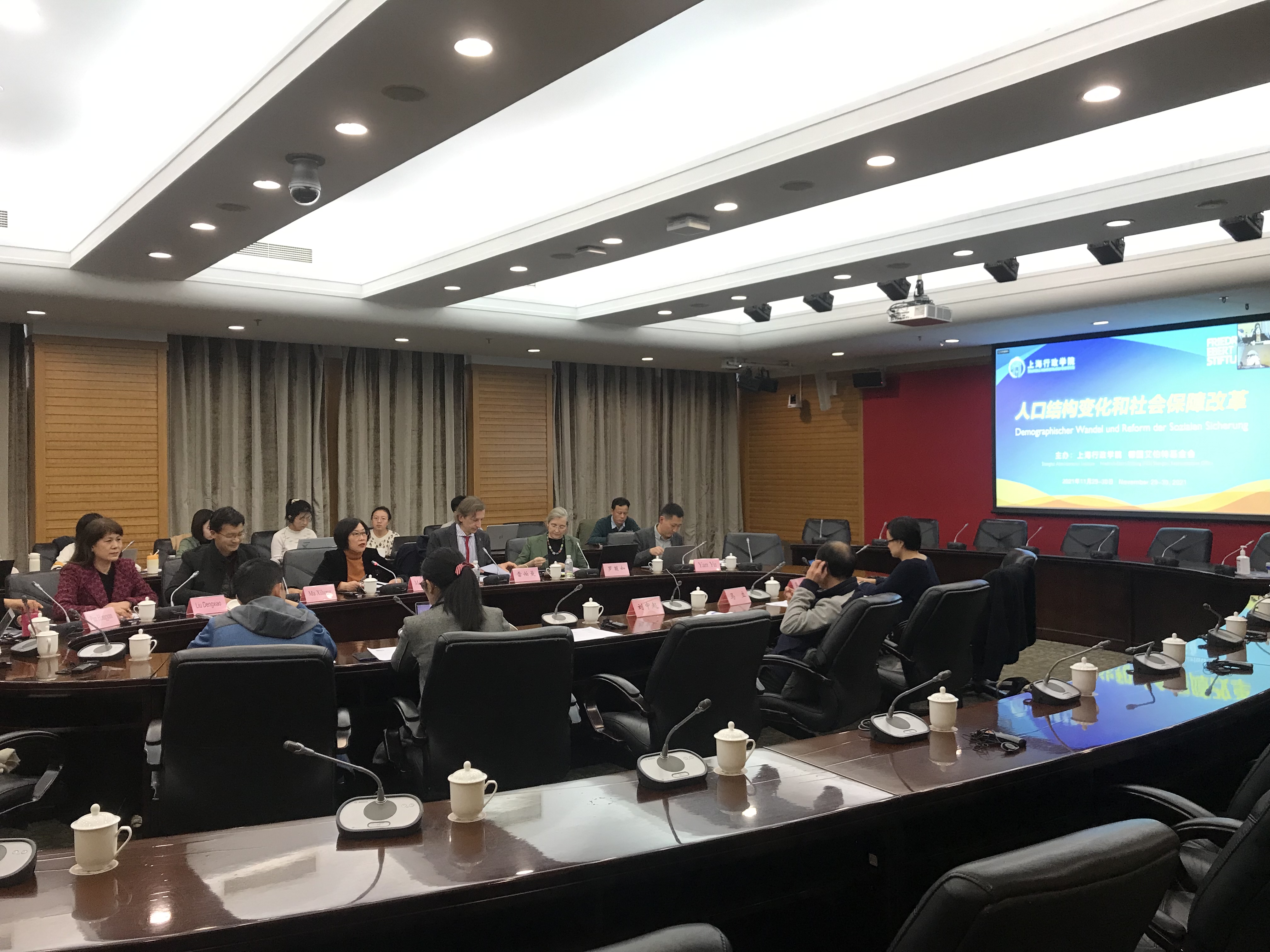
On November 29th and 30th, the Sino-German bilateral academic seminar titled "Change of Demographic Structure and Social Security Reform" was successfully held at SAI. The seminar was jointly sponsored by SAI and the Shanghai Office of the German Friedrich-Ebert-Stiftung (FES). It focused on the new challenges brought about by the change of demographic structure and on the social security issues of fertility promotion policies, the old-age insurance reform, and elderly care. The seminar aimed to enhance the exchanges and references between China and Germany on relevant issues. Professor MEI Lihong, Vice President of SAI, and Mr. René Bormann, Chief Representative of the Shanghai Office of FES, attended the seminar and delivered speeches. Nearly 30 people from China and Germany attended the seminar.
As was pointed out by Professor MEI in her speech, with the completion of the building of a moderately prosperous society in all respects, China has seen two major trends: a deep aging of the population and a decline in family fertility willingness, which have resulted in a long-term impact on the countrys economic and social development, and have raised direct demands for the social security system and the social service system. The Communist Party of China adheres to the people-centered development philosophy and has made long-term efforts to improve the social security and the social service system, but there are still many problems that need to be solved as soon as possible, especially how to deal effectively with the decline in family fertility willingness, which is a new challenge to us. As the most developed city in China, Shanghai is also the city with the highest degree of aging and the lowest rate of fertility in China. It has taken the lead in a series of explorations to deal with these problems. And Germany, as a developed country in Europe, encountered the challenge of change of demographic structure earlier in the process of modernization and formed a unique social security system, which is worthy of serious study and reference by Chinese scholars. Professor MEI hoped that SAIs Department of Sociology would give full play to its advantages in the discipline and further highlight its research specialties in these aspects.
The seminar was divided into four sessions, each composed of a themed dialogue and a free discussion. Professor PAN Hongyan and Associate Professor ZHANG Xiaojie of SAIs Department of Sociology gave keynote reports titled "New Change of Chinas Demographic Structure: Challenges and Responses" and "Reform of Chinas Old-age Insurance System: Process, Challenges and Trends" respectively. Markus Hofmann, director of Social Policies Department of the German Trade Union Confederation, and Ingo Schäfer, director of Old Age Security and Rehabilitation of DGB, commented the reports of the two professors respectively.
Professor Martin Werding,an expert of Social Policies and Public Finance of the German Ruhr University Bochum, and Dr. Cornelia Heinze, former director of the Finance Department of a German city, gave their reports titled "Birth Rate and Family Policies: Experience from Germany" and "Elderly Care: German Ways and Their Limitations" respectively. Associate Professor CHEN Yuting and Associate Professor HE Xiaolin of SAIs Department of Sociology commented their reports respectively. In the free discussion of every session, the participants of both sides asked and answers questions actively. Everyone was engaged in the heated discussions and dynamic interactions.
Professor MA Xiheng, Director of SAIs Department of Sociology, pointed out in the summary that through the two half-days in-depth exchanges, the two sides had further realized the common challenges brought about by the change of demographic structure, the comparisons between the two sides promoted the reflections on their own social policies, and many detailed issues in policy making and implementation had been touched in the discussions, which would undoubtedly contribute to the progress of social policies on both sides. For China, the change of demographic structure is an important sign of Chinas modernization entering a new stage. To create a better life for the people, we must fully realize that the change is gradual and lasting, must enhance the prediction of problems derived from the change, strengthen the forward-looking research and systematic design on social policies, strive to create more and better policy tools, and improve the social policy system continuously to make it fertility-friendly, old-age-friendly and family-friendly.
The seminar was held both online and offline.





 Shanghai public network filing 3101042008844.