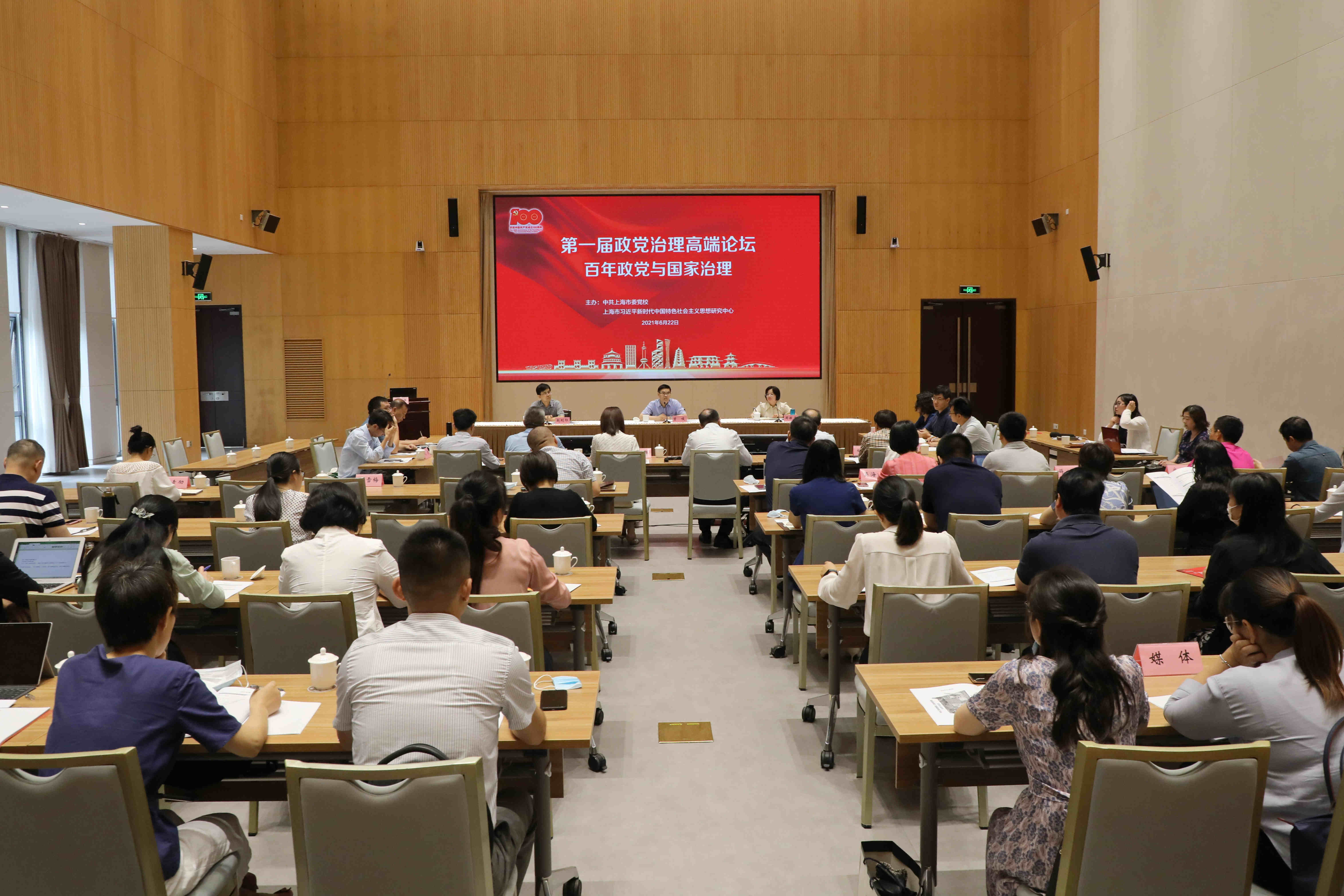
On June 22, the first high-end political party governance forum was held at the Shanghai Party Institute (SPI) on the theme of century-old political parties and state governance. The forum was co-sponsored by SPI and the Shanghai Research Center on XI Jinpings Thought on Socialism with Chinese Characteristics for a New Era, and was co-organized by SPIs Department of Party History and Building and three SPIs innovation teams that respectively focus on Party Building Theory and Practice for a New Era, the History and Experience of the Communist Party of China, and Party Consciousness Education for a New Era. More than 80 experts and scholars participated in the seminar. They came from the Party School of the Central Committee of C.P.C, Peking University, Fudan University, Shanghai Jiaotong University, Shanghai Normal University, East China University of Political Science and Law, the Party School of Zhejiang Provincial Committee of C.P.C, and the Party School of C.P.C. Jiangsu Committee, etc.
ZENG Jun, Vice President of SPI, gave an academic speech on the theme of Approaching Political Parties and Going into Political Parties, centering on deepening political party research. He pointed out that political party research can be made from two perspectives, the external one and the internal one. At present, many studies are made from the perspective of the external performance of a political party, exploring the mechanism, system, methods, and policies that it applies to achieve such performance. The focus is placed on the external nature of the partys governance. Whether it is studying the external behaviors of a political party or studying the interaction between a political party and other political subjects, the party is regarded as a whole, and observed and analyzed from multiple aspects. It shows that people are approaching political parties and the Communist Party of China. The study of a political party cannot stop at its history. An important phenomenon has not been well explained. Why do political parties differ in their forces? Why has the Communist Party of China maintained a good performance for a long time? To answer these questions, approaching a party from the outside is not enough. We need to go into the party and reveal the internal incentives and hidden codes of the partys operation. This is the internal perspective, which examines the internal structure, mechanism, and various internal governance behaviors of the party. A party should solve its own problems before addressing external issues. It is more valuable to study the partys internal organizational system and its effects than to study the external behaviors of the party. The external and internal perspectives are complementary and interactive. Organizing capacity determines fighting capacity. To improve fighting capacity and achieve external goals, a party needs to make a series of corresponding adjustments internally. In the research made from the internal perspective of going into political parties, our focus is often limited to the management of party members and leaders and the organizational issues. We have not reconsidered party building from the theoretic perspective of modern organization and management. It is necessary to absorb and learn from foreign research methods on party organizations, as well as the new achievements of social organization and economic organization, thereby updating the analytical methods, analytical perspectives and core concepts of party building research.
At the one-day seminar, 16 experts and scholars carried out an in-depth discussion on four topics: Theoretical Dimensions of Party Governance, the Way of Governance of a Century-old Party, Party Governance and State Governance, and Party and State in a Comparative Perspective. From the external and internal perspectives of party research, they discussed the external and internal governance behaviors of political parties. All experts at the seminar agreed that the research on party governance must update the analytical methods, analytical perspectives, and core concepts, achieve a revolutionary transformation of the research paradigm, build a paradigm with Chinese characteristics for the theoretical party research, clarify the key concepts of party governance, and strengthen the systematic, historical and full-process research on the governance of Marxist political parties. The ideological exchanges and collisions of the scholars from various Party schools and universities provided new perspectives for examining and observing the governance of political parties.
To meet the requirement of high-quality development and build high-level academic exchange platforms, SPI has organized a high-end urban governance forum and a high-end political party governance forum since 2020. Centering on the main work and main courses of Party schools, the two forums explored the frontier achievements of relevant disciplines and expanded the breadth and depth of academic exchanges, under the support of SPI(SAI)s key disciplines of public management, Party history and Party building, and political science. The two forums contributed to the consolidation of the foundation of relevant disciplines and to the formation of SPIs academic brand.



 Shanghai public network filing 3101042008844.