On the afternoon of April 27, the 9th Marxist Innovation Forum titled “Theories of and Practices in Completing the Building of a Moderately Prosperous Society in All Respects” was held at SPI. The Marxist Innovation Forum aimed to build a high-end academic exchange platform guided by XI Jinping’s Thought on Socialism with Chinese Characteristics for a New Era. Focusing on the major theoretical and practical issues in the construction and development of the country and Shanghai, the Forum tried to send out SPIs voice continuously in promoting Marxist theoretical innovation. TheForum specially invited Professor XIE Yue of the School of International and Public Affairs of Shanghai Jiao Tong University, Professor WANG Xiaolin of the Six Industries Institute of Fudan University, and Professor GUAN Jinsheng, Director of the Department of Scientific Socialism of SPI to make keynote speeches.
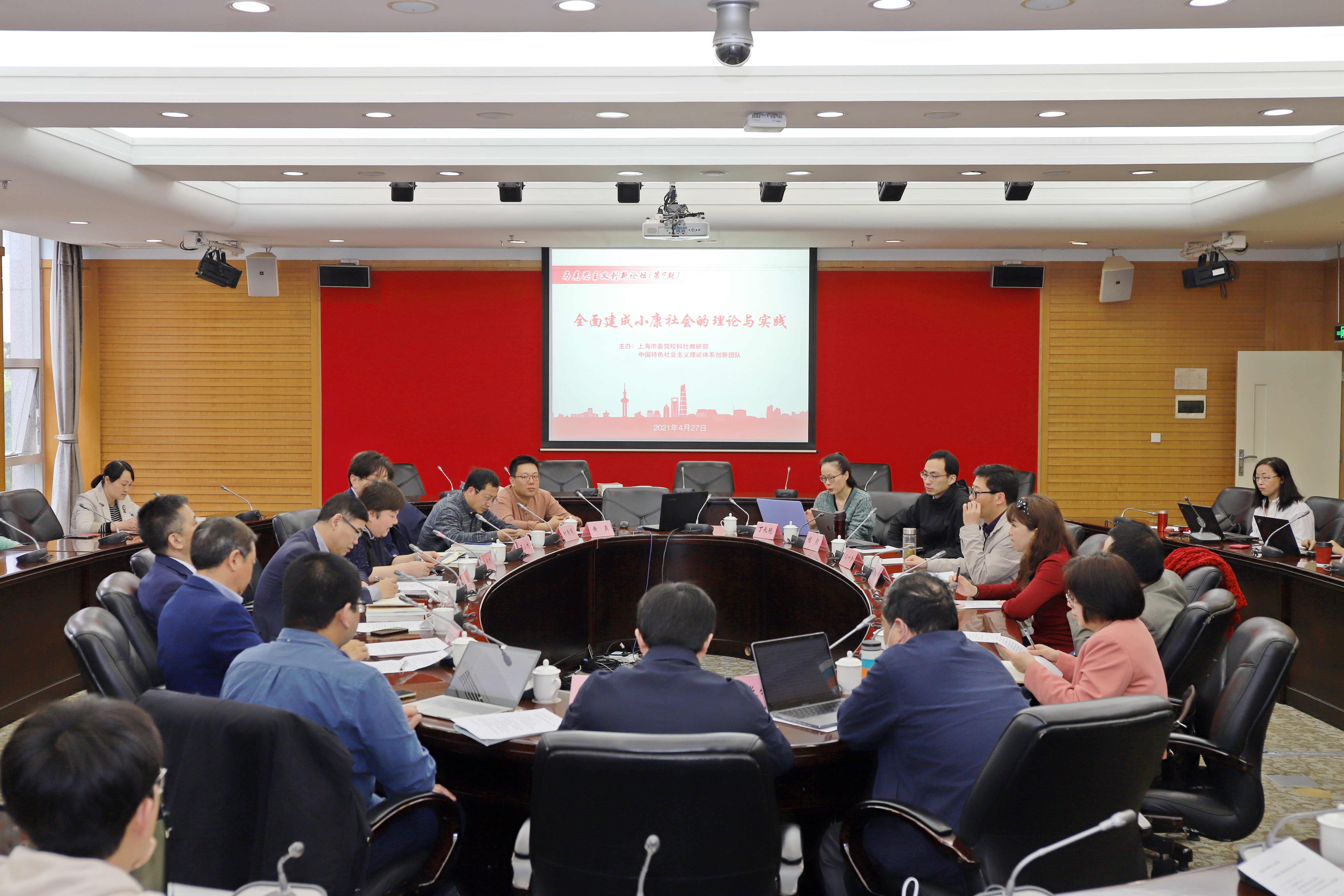
Around the title of The Political Logic of Chinas Poverty Control and Its Transcendence of Western Welfare State Theory, Professor XIE Yue summarized Chinas exploration and good experience in poverty alleviation and their international significance. He believed thatChina’s poverty governance solved the global difficulty in poverty reduction of developing countries; the core of the successful experience was increasing the state’s basic rights in poverty governance to ensure the sustainability and accuracy of poverty governance; the advantage of rationalizing the authorities of the Central Committee and raising the social welfare of impoverished population to a national strategy stimulated the vitality of local governments and the society in poverty governance.
Professor WANG Xiaolin focused on the anti-poverty theoretical framework systems with Chinese characteristics, including the people-centered institution system, the three-pillar policy system of poverty-reduction economic growth development policies, inclusive social development policies, and multi-dimensional targeted poverty alleviation policies, and the powerful social execution.
Professor GUAN Jinsheng believed that Chinas realization of moderate prosperity in all respects was a key milestone in the final realization of the great rejuvenation of the Chinese nation, and it had far-reaching influence worldwide; it demonstrated the people-centered development philosophy to the world, manifested the global vigor and vitality of scientific socialism, boosted the exploration of the diversity of human civilization, and provided a powerful impetus for building a community of common destiny for all mankind.
During the exchange session, the attendees had a further in-depth discussion on such issues as poverty reduction in developed countries, Chinas counterpart poverty alleviation system, and new ideas for industrial poverty alleviation.
Professor ZENG Jun, Vice President of SPI, made a summary of the Forum. He pointed out: on the one hand, academic research must correctly handle the relationship between theory and practice. Academic construction must first be oriented to practice, and the theoretical framework must be reconstructed on the basis of a deep reflection on practice. On the other hand, we must let the world understand the theoretical construction of Chinas practice. Chinas practice is original, with both Chinese characteristics and global significance. In terms of explaining it with academic language, China still has a long way to go.




 Shanghai public network filing 3101042008844.