In July 1921, the Communist Party of China (CPC) was born in Shanghai, marked by the convening of its First National Congress. However, in the academia it is generally believed that 1920-1922 was the founding period of the CPC. From July 16 to 23, 1922, the Second National Congress of the CPC was held in Shanghai. "In a sense, the Second National Congress really completed the CPCs founding course. The First National Congress announced CPCs founding, while the Second National Congress formulated the democratic revolution program and the first Party Constitution, which marked the successful completion of CPCs founding," said Professor YANG Jun from Shanghai Party Institute at the Three-scholar Talk on 100-year History of the CPC held on April 15. Professor YANG, who was also host of the talk, came to the point right away.
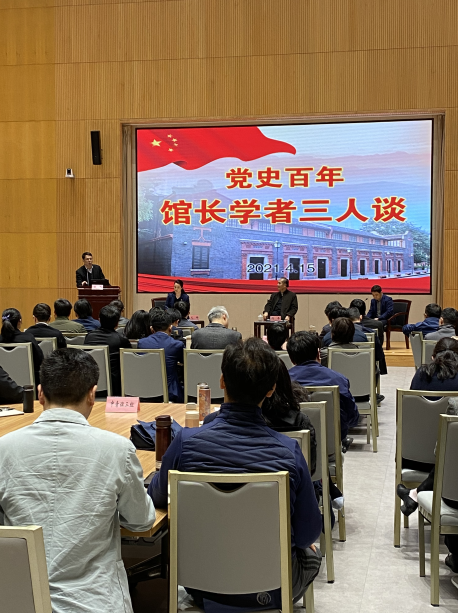
The talk was focused on "CPCs Second National Congress". What is the historical significance of the Second National Congress? Why was the Party Constitution formulated at the Second National Congress? Why is it inevitable that the CPC was born in Shanghai? ...... At the talk, Professor YANG passed all these questions that the trainees were interested in to XIN Ping, Chairman of the Shanghai Society of History of Communist Party of China, and YOU Wei, the Party Branch Secretary and Deputy Curator of the Memorial Hall for the CPCs Second National Congress. The three scholars gave a unique interview-lecture centering on such topics as the cultural relics collected by the Memorial Hall, their historical significance, and the utilization of revolutionary resources.
From the First National Congress to the second one, CPCs growth proved the vigorous vitality of "revolutionary genes".
YOU Wei pointed out that the First National Congress announced the Partys founding and the maximum program established by it set up an ambitious goal for the communists, while the minimum program proposed by the Second National Congress gave us a practical guide on how to achieve the goal step by step. "Back then, all the warlords were fighting against each other, and there was no clear direction as to what was right. Yet, in one year, the young but wise CPC gradually developed the democratic revolution program of fighting against imperialism and feudalism, and decided to cooperate with any organization working for this goal. So, our Party made a high-minded proposal: establishing a united front for democracy, which was the predecessor of the United Front."
Apart from "proposing the Partys democratic revolution program of fighting against imperialism and feudalism for the first time" and "proposing the Partys thought of the United Front for the first time", the Second National Congress created some other "firsts" in CPCs history: formulating the first Party Constitution, openly publishing the Manifesto of the Communist Party of China for the first time, proposing quite complete requirements to the workers movement, the womens movement, and the youth movement for the first time, deciding to join in the Communist International for the first time, and proposing the slogan of "Long live the Communist Party of China" for the first time.
The emergence of the first Party Constitutionwas an outstanding contribution of the Second National Congress. What basic conditions were formed in just one year for the generation of the Party Constitution? YOU Wei believed that there were two reasons. Firstly, the expansion of the organization at the time required a constitution to regulate the words and deeds of the Party members. "When the First National Congress was convened, there were more than 50 Party members across the country. After a years development upon the convening of the Second National Congress, the number increased to 195." Secondly, the practice of revolutionary activities provided certain foundation for the formulation of the Party Constitution. In that year, the explorations of the workers, farmers, youth, and womens movements all started.
"The first Party Constitution conformed to the Chinese conditions. At the time, the CPC did not simply copy foreign constitutions in spite of the Chinese circumstances. Instead, it formulated the Partys first general constitution and fundamental law of codes of conduct based on the actual conditions of the Chinese revolution. Every page and every clause in the constitution obviouslyshowed Chinese characteristics and conformed to the Chinese conditions," said YOU Wei.
CPCs emergence in Shanghai was an inevitability of modern history.
Given the achievements of the Second National Congress, CPCs development in just one year proved the vigorous vitality of the "revolutionary genes". Looking further back, we can see that CPCs emergence originated from profound historical basis and inevitability. In XIN Pings view, across China in the 20th century, only Shanghai had the conditions for the emergence of a new-type proletarian party. He extended the vision back to modern Shanghai and revealed to the trainees the historical inevitability of CPCs emergence in Shanghai:
Shanghai is the birthplace and base camp of the working class. XIN Ping pointed out that, thanks to Shanghais special geopolitical structure, it took only 10 years for Shanghai to become Chinas largest trading port after the city opened up its ports. The concessions brought into Shanghai all the most advanced Western production modes, productivity, and lifestyles since the Industrial Revolution. "Foreign-owned factories brought out the first generation of Chinese workers. More importantly, the assembly lines of the heavy industry enterprises brought out the first generation of industrial workers, who were truly the core of the working class. According to statistics in 1919, the working class in the whole country totaled less than 2,000,000 people, more than 500,000 of whom were in Shanghai, and the industrial workers nationwide totaled 200,000, 180,000 of whom were in Shanghai. Shanghai was also where class contradictions and ethnic conflicts were the most concentrated and appeared the earliest in China."
In addition, as a city of immigrants, Shanghai was mostly characterized by openness, inclusiveness, and innovation. It was also the most open global city. As a cultural center, Shanghai produced the countrys earliest schools, entertainment facilities, news agencies, newspapers, publishing houses, playgrounds, etc. "Some comrades of the Communist International came to Shanghai. They were surprised to find that socialism and communism were actually promoted in Shanghai, which could be seen nowhere else in the world." The merge of all those conditions made the emergence of the CPC in Shanghai inevitable.
Replaying major events in CPCs history from different levels in the form of dialogue
The series of activities for the Three-scholar Talkon 100-year History of the CPCwas an innovative model of teaching and learning the Partys history launched by Shanghai Party Institute. Why adopt such a form to teach the Partys history? XU Jiangang, Executive Vice President of the Institute, said that they hoped to replay major events in the Party’s history at different levels through the dialogues among the scholars. "The whole process is an innovation of the Institutes teaching system. It will be all right if you ask a teacher to explain the Party’s history clearly from beginning to end, but it will lack variety. The interpretations from varied perspectives by a memorial curator, an expert of the Partys history, and a college teacher will present a colorful replay of the major historical events at different levels," said XU.
TheThree-scholar Talk on 100-year History of the CPC has been held three times since it was started on March 18 this year, with the first two centered on "The First National Congress of the CPC" and "The Fourth National Congress of the CPC" respectively. The trainees said that, with the current closure of the memorial halls of the first, second, and fourth national congress of the CPC, the introduction of revolutionary resources into the classroom and the mode of teaching politics through academics could improve the attractiveness, participation, and impact of learning the Partys history.


 Shanghai public network filing 3101042008844.