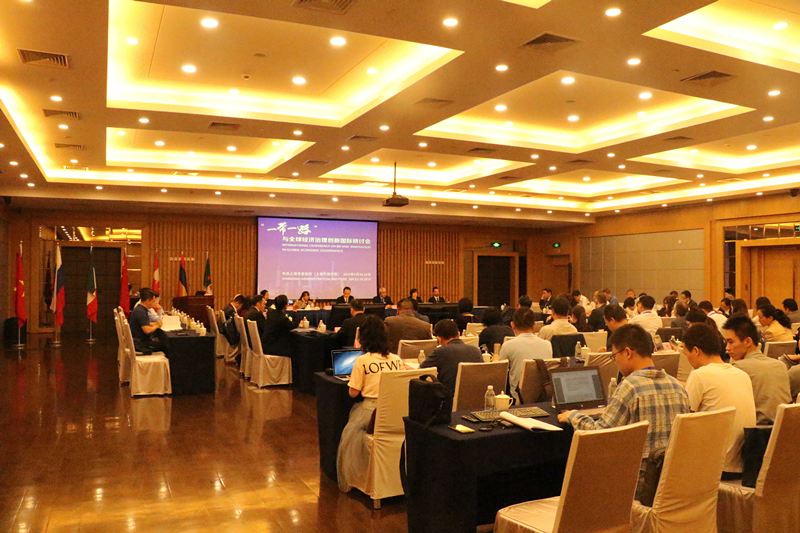
The International Seminar on BRI and Global Economic Governance Innovation was held at the Shanghai Party Institute (SPI) on September 23 and 24. Professor GUO Qingsong, Vice President of Shanghai Party Institute (Shanghai Administration Institute), delivered an opening speech the opening speech at the opening ceremony and a summary at the closing ceremony. Professor MEI Lihong, Provost of SPI presided over the opening ceremony.
As GUO Qingsong pointed out, the Belt and Road Initiative (BRI) proposed by President XI Jinping in September 2013 has received extensive welcome and increasing responses by the international community. The cooperation initiative on integrated development is an important practice of China’s participation in global governance. It has provided an opportunity for various countries to work together and build a community with shared interests and a shared future based on mutual benefit. The collaboration in the BRI has opened up a new space for the worlds economic growth, built up a new platform for the international trade and investment, explored new practices to improve global economic governance, and made new contributions to improving the welfare of the people of various countries. It is a common path to opportunities and prosperity. In the future, the BRI partner countries can furtherpromotethe BRI through shared resources, information and achievements. The high-quality international academic exchange has deepened the understanding of the relationship between the BRI and global economic governance innovation, of the contributions made by the integrated development to global economic governance innovation, and of the path and meaning of enhanced cooperation between China and other countries under the BRI.
According to ZHOU Zhenhua, President of the Shanghai Economist Association and the Shanghai Global Cities Institute, the BRI represents Chinas leading role in globalization. The initial investment and trade axis of globalization began with the “north-south axis” characterized by the division of labor in manufacturing and processing and the division of resources between developed and developing countries. Later, the axis changed to the “east-west axis” reflected in the high end and low end of the global industrial chains. Multinational companies played a very important role in it. The “Belt and Road” is a new axis characterized of the new international division of labor brought by integrated industries. It represents a new pattern of the new round of globalization. In terms of global economic governance, the BRI is neither based on the geopolitical theory nor aimed at controlling a certain region, but is centered on seeking shared benefits through consultation and collaboration and building a community of common destiny for the human kind.
QUAN Heng, Vice Chairman of the Shanghai Federation of Social Science Associations, put forward that, given the current dilemma in economic globalization, Chinas economic and social development has entered a new era when it is necessary to form a new pattern of comprehensively open economyto create an institutional environment with more international competitiveness. The BRI is of great practical significance to both China’s upgrade and transformation of its open economy and the promotion of globalization. With the BRI, China should participate more actively in global economic governance. We need to maintain the rules of multilateralism and push for the reform of these rules as well. In this process, we will contribute to the improvement of the global governance system and come up with a solution of our own.
On the one-and-a-half-day seminar, more than 80 scholars fromChina, Mexico, Algeria, Canada, Vietnam, Armenia, Russia and other countries were engaged in in-depth exchanges and discussions on such issues as the opportunities brought by the BRI to the world, the BRI and the new pattern of China’s open economy, the interconnection of development strategies between China and the BRI partner countries, the economic cooperation of BRI countries and global economic governance innovation.




 Shanghai public network filing 3101042008844.