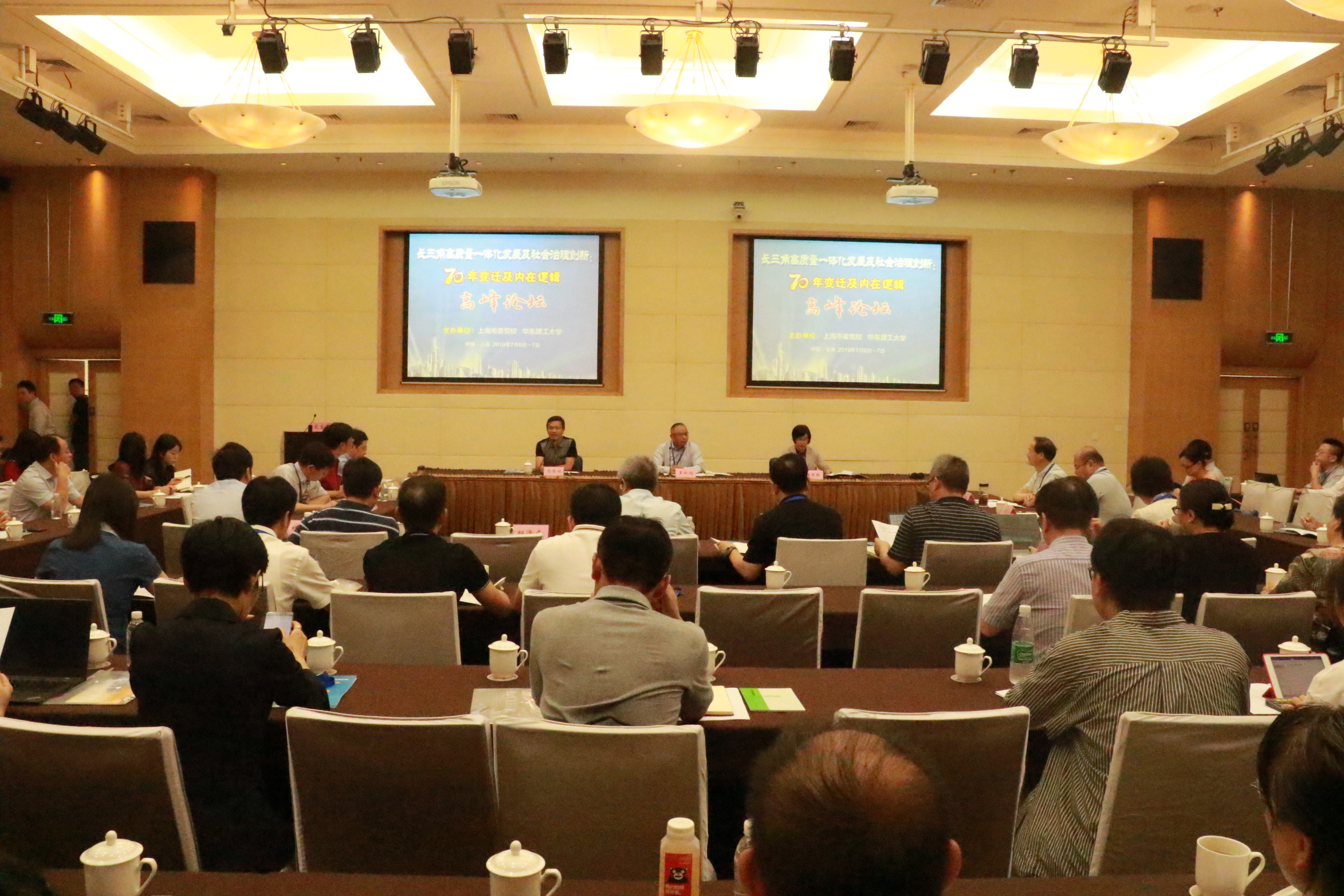
From July 6 to 7, the Summit Forum on High-quality Integrated Development and Social Governance Innovation of the Yangtze River Delta --– Changes over the Past 70 Years and the Internal Logic was held at Shanghai Party Institute of the CPC (SPI). Co-organized by SPI and East China University of Science and Technology, the forum brought together reputed universities including Peking University, Tsinghua University, Renmin University of China, Chinese Academy of Social Sciences, Nanjing University, Fudan University, Zhejiang University, etc., over 20 well-known experts in the field of social governance at provincial Party institutes in the Yangtze River Delta region, and more than 50 representatives of government leaders and practitioners in social governance in the region. More than 200 researchers and practitioners in social governance across China attended the forum.
At the opening ceremony of the forum, Professor MEI Lihong, Provost of Shanghai Party Institute of the CPC, and Professor WU Bojun, Vice President of East China University of Science and Technology, delivered speeches. They pointed out that this forum showed joint efforts of the two institutions to bring together academic wisdom and actively implement the national strategy of Yangtze River Delta integration, and to offer gifts to the 70th anniversary of the founding of the People’s Republic of China. The Department of Sociology of SPI has accumulated rich experience for a long time in the fields of social governance, social policy, regional Party building, etc., and focused on conducting academic research based on the frontiers of practice and exerted the functions of cadre training and political consultation. The School of Social and Public Administration of East China University of Science and Technology focused on basic research and practice in academic frontiers of social governance, social policy, urban development and public economy. The research teams of the two sides strengthened cooperation, actively responded to the national strategy of the Yangtze River Delta integration proposed by the CPC Central Committee and the State Council, and established an interdisciplinary, cross-department and transboundary cooperation and exchange platform. They carried out forward-looking and strategic research on major theoretical and practical issues in regional economic development and social governance, and provided practical guidance on the hotspots and difficult issues in the integration process, thus to make greater intellectual contributions to regional social governance capabilities, and jointly enhance the academic influence in this field.
In the major lectures session on July 6, Professor QIU Zeqi, Director of the Center for Sociological Research and Development Studies of China, Peking University, Professor ZHANG Yi, Dean of National Institute of Social Development, CASS, Professor FENG Shizheng, Dean of School of Sociology and Population Studies, Renmin University of China, Professor CHENG Boqing, Dean of School of Social and Behavioral Sciences, Nanjing University, Professor WANG Tianfu, School of Social Sciences, Tsinghua University, Professor MAO Dan, Department of Philosophy and Sociology, Zhejiang University, Professor TANG Yalin, School of International Relations & Public Affairs, Fudan University, Professor WANG Yijie, Deputy Dean of School of Public Administration Hohai University, Professor WU Zongyou of School of Social and Political Science, Anhui University, Professor MA Xiheng, Director of the Department of Sociology, Shanghai Party Institute of the CPC, Professor HE Xuesong, Dean of the Social and Public Administration School, East China University of Science and Technology, and other experts and scholars made wonderful talks on regional development strategy, development and order construction, megacity governance, the Yangtze River Delta integration and the role of Shanghai, etc. The participating experts believed that the regionalization of global development and China’s new development pattern required us to pay more attention to the connotation and quality of the Yangtze River Delta integration that included economic integration, administrative integration, social integration, etc. Social governance in this region should establish the concept of social integration, strengthen integration thinking in areas such as governance mechanisms, social policies, public services, etc., better adapt to deeper, broader and more frequent social mobility, give full play to Shanghai’s leading role in refined governance as a megacity, and properly respond to and deal with regional differences and policy barriers formed in the past.
In the morning of July 7, five sub-forums centered on the policy design for social governance in the Yangtze River Delta, the innovative practice of social governance in the Yangtze River Delta, self-governance of the residents led by Party-building, integration of the Yangtze River Delta and optimal management of land and resources, community-level governance and social construction in the Yangtze River Delta region, etc. ZHANG Shuping, Director of Grassroots Organs of Political Power Construction Office of Shanghai Civil Affairs Bureau, HU Yuezhong, Deputy Director of the Suzhou Civil Affairs Bureau, YANG Tingting, Director of Grassroots Organs of Political Power and Community Governance Office of Hangzhou Civil Affairs Bureau, etc. shared their views on policy design. ZHANG Tingting, Secretary of Party Working Committee of East Nanjing Road Sub-district, Huangpu District, Shanghai, WANG Jun, Director of Shishan Hengtang Sub-district Office of Suzhou New District, ZHANG Anping, Secretary of Party Working Committee of Zhoujiadu Sub-district, Pudong New Area, Shanghai, etc. shared their innovative practice. In addition, experts from the Party school system of the three provinces and one city, namely, Jiangsu Province, Anhui Province, Zhejiang Province, and Shanghai in the Yangtze River Delta region and the Land Resources Research Team of the Public Administration Discipline of East China University of Science and Technology exchanged their wonderful views on relevant topics.
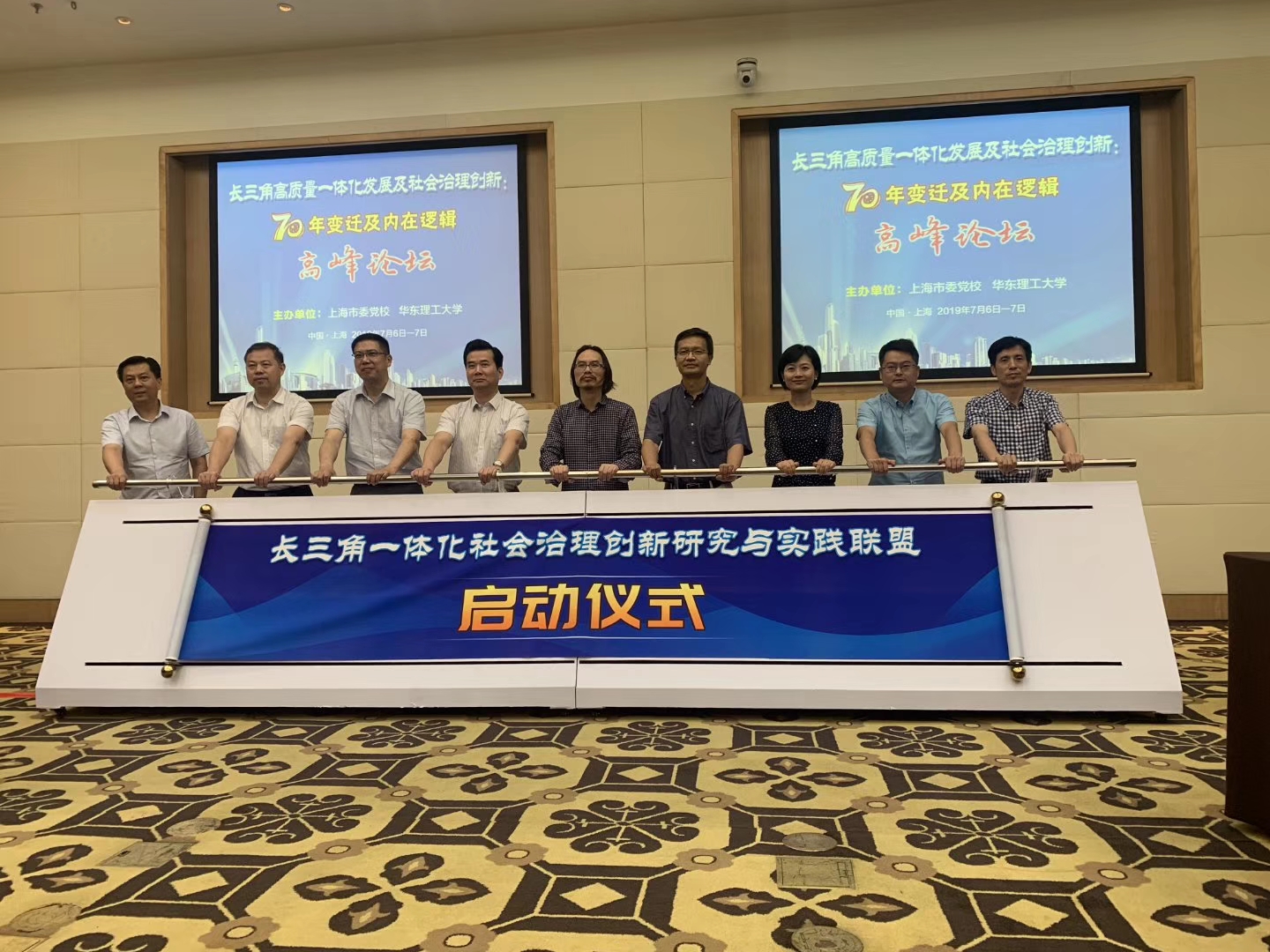
Alliance for Integrated Social Governance Innovative Research and Practice of the Yangtze River Delta Region, an important outcome of this forum, led by the Social Science Teaching and Research Department of Shanghai Party Institute of the CPC, Social and Public Administration School of East China University of Science and Technology, and Institute of Advanced Studies in Social Sciences of East China University of Science and Technology, supported by many relevant departments of provinces and cities in the Yangtze River Delta region, was officially launched at the closing ceremony. The Alliance is a cross-regional and transboundary cooperation and exchange platform jointly established by academia, government departments and social forces to enhance social governance capacity building. It aims to promote the institutionalized, normalized cooperation of relevant entities in social governance innovation of the Yangtze River Delta region. In addition, the attendees proposed to establish a joint research platform, namely, “Yangtze River Delta Integrated Governance Research Institute” to provide academic support for promoting social governance practices in this region.


 Shanghai public network filing 3101042008844.