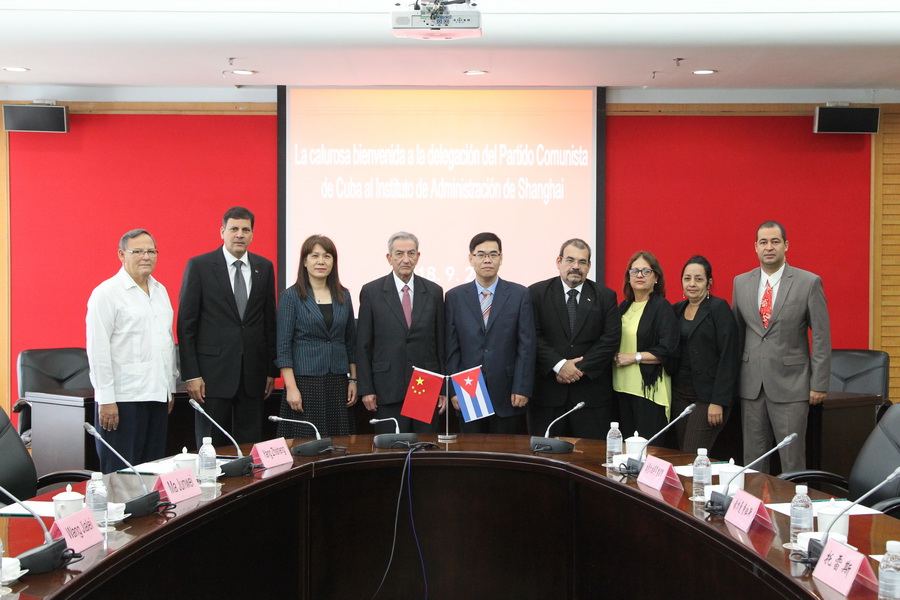
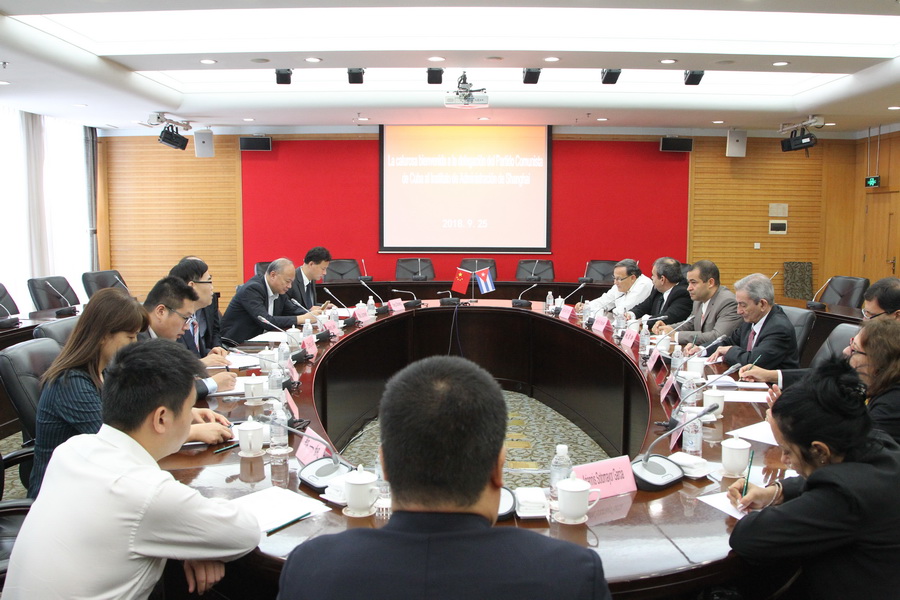
On September 25, a delegation including 6 cadres from the Communist Party of Cuba paid a visit to Shanghai Administration Institute in the company of the Consulate General of the Republic of Cuba in Shanghai, and the relevant leaders from the International Department of Central Committee of CPC and the Foreign Affairs Office of Shanghai Municipal People’s Government (FAO). ZENG Jun, the vice principal of the Institute chaired the meeting. Ms. LIU Dengxiao, the director of the Foreign Affairs Division of SAI and relevant officials also attended the meeting.
ZENG Jun extended his welcome to the delegation and gave a detailed introduction to the basic situation, history, curriculum provision, training courses, training methods and faculty of Shanghai Party Institute of CPC & Shanghai Administration Institute. ZENG Jun pointed out that the CPC has attached great importance to the training of cadres since its foundation, and formed a complete package of cadre training system over time. At the Party Center level, we have the Party School of the CPC Central Committee, while at the local level we have party schools and administration institutes for training cadres at corresponding levels. As for training category, the Institute has set up comprehensive training classes, with trainees from the Party committee, the government, the NPC, the CPPCC, higher schools and research institutes, state-owned enterprises and social organizations for general knowledge and skills training. The Institute also designs special-topic seminars for trainees in the same work fields to study and solve problems to promote their work. The courses mainly include theories of the Party, the Party spirit, practice of reform and development, governance and cadre’s ability enhancement. The courses offered by the Institute fully reflect the requirements of “being politically strong and highly competent” as stressed to all party members by President XI Jinping in his report at the 19th CPC National Congress. In addition, the Institute provides comprehensive modern training methods including seminars, on-site teaching, case analyses and scenario simulations, giving full play to the leading role of teachers and the role of trainees as main players. As for faculty, the Institute now has more than 150 full-time teachers and over 130 part-time teachers. 60% of part-time teachers are from the functional departments of the CPC and the government, having richer experience. The reasonable deployment of full-time and part-time teaching teams ensures high-quality training theoretically and practically. ZENG Jun stressed the close relationship between the Institute and Cuba on cadre training, as the Institute receives trainee teams from Cuba every year and send teachers to Cuba for lecturing. He hoped that the two sides would further promote close exchanges to expand the cooperation.
Mr. Jose Ramon Balaguer, the head of the delegation, the secretary of the Secretariat of the Central Committee of the Communist Party of Cuba and the International Relations Minister, expressed his thanks to the Institute for its hospitality. He spoke highly of the Institute’s work on education and training, and pointed out that cadres are the cornerstone and backbone of the Communist Party’s cause, and it is very important for the implementation of the Party’s line and policies to deliver theory and practice education to the cadres by the party school. Cuba makes much account of the cooperation with China on cadre education and training. China’s achievement in development is obvious to all. Cuba is expecting to learn more experience of the CPC in cadre education and training in different historical eras and to enhance the cooperation and exchange with China in cadre training.
After the meeting, ZENG Jun accompanied the delegation to visit the Institute’s training rooms for emergency management, media communication and reform & open-up, and introduced to the delegation the operation of these training rooms.


 Shanghai public network filing 3101042008844.