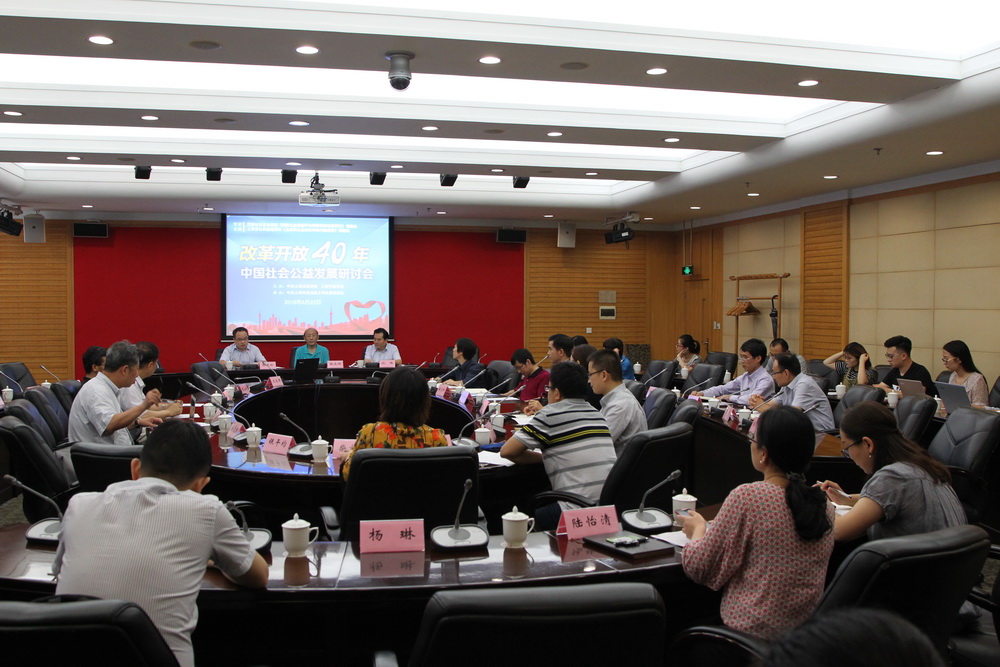
On the afternoon of June 22, Shanghai Party Institute of CPC (SPI) & Shanghai Administration Institute (SAI) held a seminar on “China’s Social Public Welfare Development in the Last 40 Years of Reform and Opening Up”. SHEN Wei, Executive Vice Principal of SPI & SAI, attended and made a speech; GUO Qingsong, Vice Principal of SPI & SAI, presided over the opening ceremony; XU Yongxiang, President of China Association for Social Work Education and a professor of East China University of Science and Technology, made a keynote speech; and Professor GUAN Xinping, Vice President of Chinese Sociological Association and Dean of the Institution of Social Development and Administration, Nankai University, briefly summarized the seminar.
SHEN Wei said that within the last 40 years of reform and opening up, with steady advancement of legislative, policy and system reform, Chinas social public welfare has gradually developed towards the building of service brands and the formation of health and public welfare culture. However, we should note that Chinas social public welfare undertakings are still at the development stage when compared with those of developed countries and thus have a relatively large space for improvement. Currently, Shanghai is standing at a new starting point of development and trying to continue acting as a pioneer in the national reform, opening up and innovative development in a new era. It is firmly pursuing the development orientation of excellence in the new era, and striving to build Shanghais strategic advantages in four aspects of development and fully launch the four major brands of Shanghai Service, Shanghai Manufacturing, Shanghai Shopping and Shanghai Culture. This seminar is a favorable try made by the academic circle and practical circle to jointly establish an international social public welfare dialogue system with Chinese characteristics in hope that experts and scholars give suggestions to promote the building of Shanghai into “a city of public welfare” and the continuously enhanced demonstration, guidance and radiation effects of Shanghais social undertakings and constantly improve the Shanghai public welfare service and culture brands.
XU Yongxiang mentioned that public welfare and charity had played an important role in promoting Chinas social construction and thickening the CPCs ruling foundation and thus should be effectively carried out under the guidance of the Party building. Chinas social public welfare development under the guidance of Xi Jinping Thought on Socialism with Chinese Characteristics for a New Era and the spirit of the 19th CPC National Congress should be emphasized from the perspective of the ruling foundation of the CPC. All of us should focus on continuous transformation of Chinas social principal contradiction to push Chins modernization to a new high.
GUAN Xinping said that within the 40 years of reform and opening up, significant progresses had been made in China’s social public welfare development, that we should view the issue of social public welfare from the perspective of development and continuously promote social public welfare development to a higher level in terms of capabilities, norms, status and innovation. In addition, it should be noted that the governments purchase of services from the society is conducive to improving administrative efficiency, providing more professional services for the public and cultivating and developing social organizations, but the government cannot rely too much on service-purchase and needs to further strengthen relevant scientific and planned constructions.
At the seminar, the attendees deeply discussed and exchanged the theoretical problems about public welfare development in the last 40 years of reform and opening up and current issues about Chinas public welfare development. Professor ZHANG Wenhong, Dean of the School of Sociology and Political Science of Shanghai University, reviewed and analyzed the development processes of Chinas social policies and public welfare undertakings within the last 40 years of reform and opening up; Professor XU Daowen, Deputy Dean of College of Psychology and Sociology of Shenzhen University, discussed the new tendency of Chinas governance mode in combination with social work practices in Shenzhen; Doctor CHAI Dinghong from East China Normal University discussed farmers choices and the implementation approach of rural revitalization strategy through conducting empirical analysis; ZHAO Wenpin, an associate professor in Shanghai Institute of Development Studies of the SPI, discussed how to link instrument rationality and value rationality in public welfare development according to current public welfare development phenomena and problems; Doctor ZENG Yonghe, Deputy Director of Shanghai Administration Bureau of NGOs, shared his ideas on transformation and prospect of development of NGOs in Shanghai with other attendees; LU Jing, Secretary of the Party Committee and Director of Shanghai Yangpu District Justice Bureau, shared their exploration and experience in promoting political and social coordinated development and the grassroots-level social legal governance in Yangpu District; WANG Zhiyun, Secretary General of Shanghai United Foundation, introduced their Foundations innovative practices in united public welfare in detail; TANG Yaling, Vice President of Social Work for Public Good in Minhang District, Shanghai, communicated the exploration for building a participatory mutual-assistance community based on local public welfare granary kernel.
The seminar was undertaken by Shanghai Institute of Development Studies of SPI & SAI, with academic support from the research group of “Research on Innovation of Network Public Welfare Deviation Behavior Control Mechanism”, a project of National Social Science Fund of China, and the research group of “Research on the Risk of Trust in Network Public Welfare”, a project of Shanghai Planning Office of Philosophy and Social Sciences. More than 50 theoretical and practical workers from universities and colleges and scientific research institutions in Tianjin, Liaoning, Jiangxi, Sichuan, etc. and from relevant Party and government departments, academic circle and the Party schools and systems in Shanghai also participated in this seminar.


 Shanghai public network filing 3101042008844.