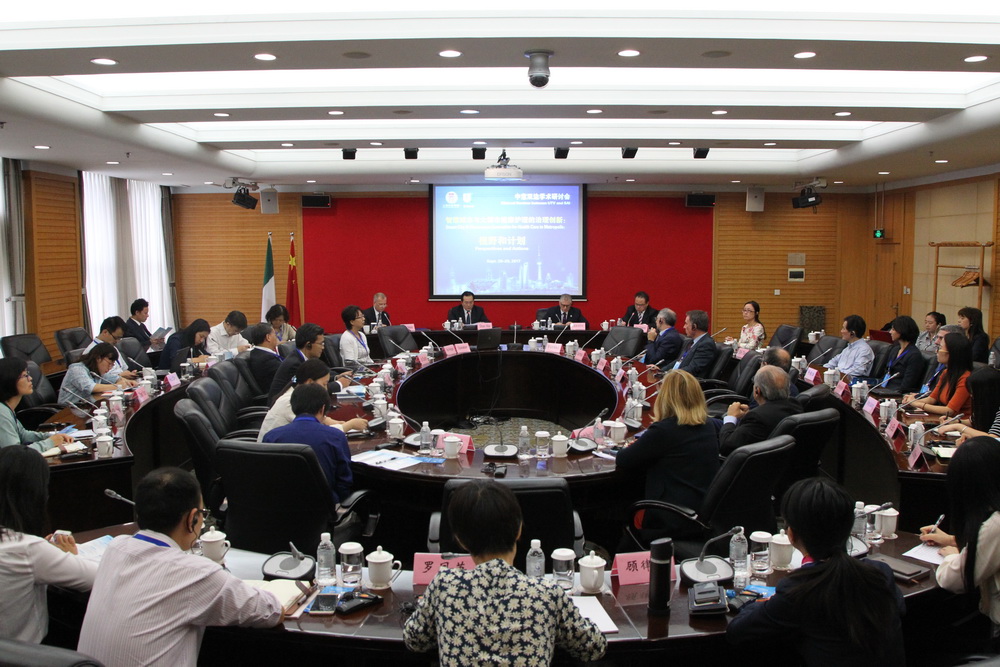
On September 28, SAI and the University of Rome held a bilateral seminar themed “Smart City & Management Innovation for Healthcare in Metropolis: Perspectives and Actions”. Focusing on the important instruction of General Secretary XI Jinping on the “Strategic Plan for Healthy China 2030 Program” and the establishment of a socialist healthcare management system with Chinese characteristics, the two sides discussed points involving the management innovation for healthcare in metropolis and exchanged their successful experience and development direction of healthcare support in the process of building a smart city.
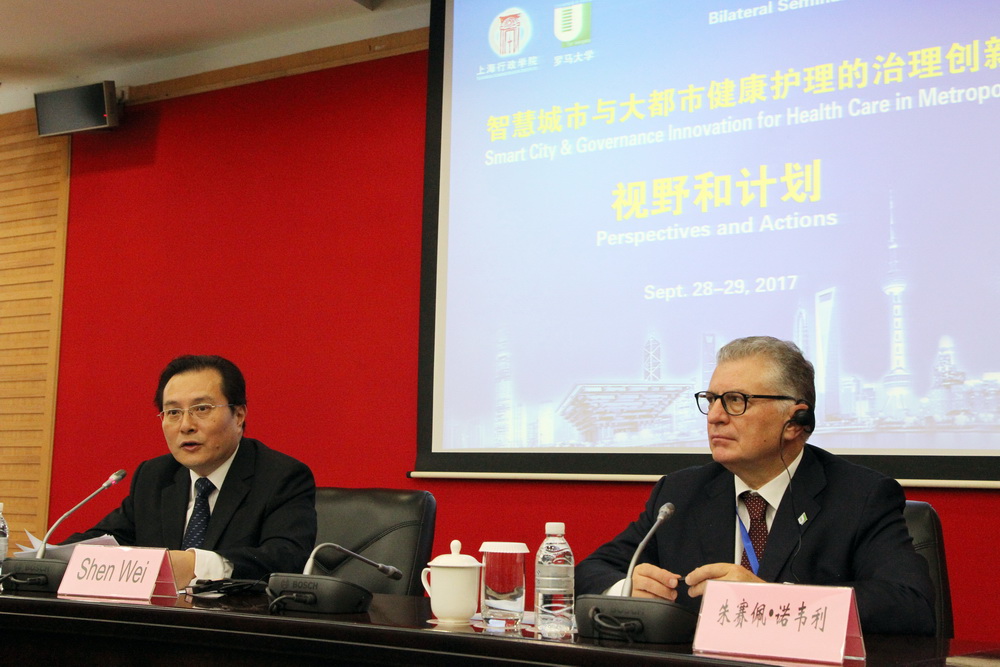
SHEN Wei, Executive Vice President of SAI, made an academic speech. Vice President GUO Qingsong presided the opening ceremony. Stefano Beltrame, Consul General of Italy in Shanghai, attended the ceremony and addressed the audience. 16 experts from Italy and China, including Prof. DAI Tao, Deputy Director of Development Center for Medical and Health Technologies of China’s National Health and Family Planning Commission, and Prof. Giuseppe Novelli, President of the University of Rome, made keynote speeches. Director MA Xiheng and Deputy Director HE Haibin from the Department of Sociology of SAI hosted the first half of the seminar; Prof. Giuseppe Novelli and Prof. Giovanni Tria, Head of School of Economics of the University of Rome, hosted the second half.
SHEN Wei mentioned in his academic speech: Health is a cornerstone for the comprehensive development and well-being of the people and a hallmark of national prosperity and social progress. In August 2016, China held the first national healthcare conference in the new century and released the Outline of Healthy China 2030 Program. President XI Jinping outlined in an important speech the overall guidelines, targets and tasks for building a healthy China from a strategic and overarching perspective and proposed principles for healthcare work, namely, “focus on the grassroots, take reform and innovation as the driving force, make disease prevention as the priority, give importance to both traditional Chinese medicine and Western medicine, incorporate healthcare into all policies, and strive for participation by all and benefits to all”. Shanghai has been attaching great importance to health promotion. Since the 1990s, Shanghai has been, under the guidance of WHO and national health authorities, actively exploring a health promotion way in line with characteristics of mega cities based on the campaign for a healthy city and under the principle of government-led multilateral cooperation and citizen involvement. With these efforts, the health of citizens has been improving and main health indicators have reached the level of developed countries and regions. The goals in the Outline of Healthy Shanghai 2030 Program conform to those in Healthy China 2030 Program, the aim of becoming an excellent global city, and the diversified health needs of the public. Shanghai is striving to become a first-rate city in Asia in terms of health by 2020 and a healthy city of higher level by 2030. According to the policies of the new national medical reform and the new circumstances and requirements of urban development, Shanghai is actively exploring policies to deepen regional medical system reform: first, improve the management mechanism and build a modern hospital management system; second, press ahead the building of a hierarchical medical system based on family doctor system; third, improve the basic medical insurance system to raise guarantee capability; fourth, improve public health service capability and public sanitation in urban areas; finally, develop smart management and smart healthcare.
Prof. DAI Tao introduced the main contents of the Strategic Plan for Healthy China 2030 Program and management innovation, and illustrated and analyzed the basic concepts, policy focus, basic principles, major tasks, and the concept change and diversified tools in health management innovation in the Outline of Healthy China 2030 Program. According to him, under the guidance of the Outline, China will give priority to people’s health and put it in a strategic position, take health as a central task, and focus on popularizing healthy life, optimizing health services, improving health support, creating healthy environment and developing health industry, in order to accelerate the building of healthy China and guarantee all-round, full-cycle protection of peoples health.
Dr. Ranieri Guerra, Head of the General Directorate for Health Prevention of the Italian Ministry of Health, introduced the Italian health prevention scheme at the national level of Italy and made a systematic analysis on the Italian response to various challenges after the financial crisis as well as how to improve heath efficiency and prevent various diseases. He held that Italy made less public medical expenses than other members of OECD, so how to improve the efficiency of the invested capital is a major issue that Italy should consider. Therefore, Italy has made fruitful exploration in public health input, attention to health prevention, intervention with cancer, chronic diseases and obesity, water safety plan, as well as infectious disease prevention and control, etc.
Prof. PAN Hongyan of the Department of Sociology of SAI, introduced children healthcare policies and practices in Shanghai, and analyzed the support for children healthcare from the perspective of “the two-child policy”. She holds that those like too much emphasis on economic input, narrow benefit scope, insufficient supporting policies and low quality of service personnel have caused many problems to children healthcare. She suggested dividing responsibilities reasonably according to the principle of “who benefits undertakes the responsibility” and making innovation in the supply of services by drawing experiences from foreign countries.
Dr. HE Xiaolin from the Department of Sociology of SAI made a featured speech themed “Problems and Countermeasures in the Improvement of Basic Public Services for Community Health in the Context of Healthy Shanghai 2030 Program”. In his speech, he made an in-depth analysis on the problems faced by Shanghai communities in public healthcare services, including the implementation only at the administration level, fragmented policies, single supply channel, low matching rate of supplies and demands, and low participation rate. He suggested improving the system and content of basic public health services, making uniform citizen public health service supply card, establishing an assessment system for public health service supply, building a part-time community health instructor team, and uniformly carrying out citizen public health service publicity, etc.
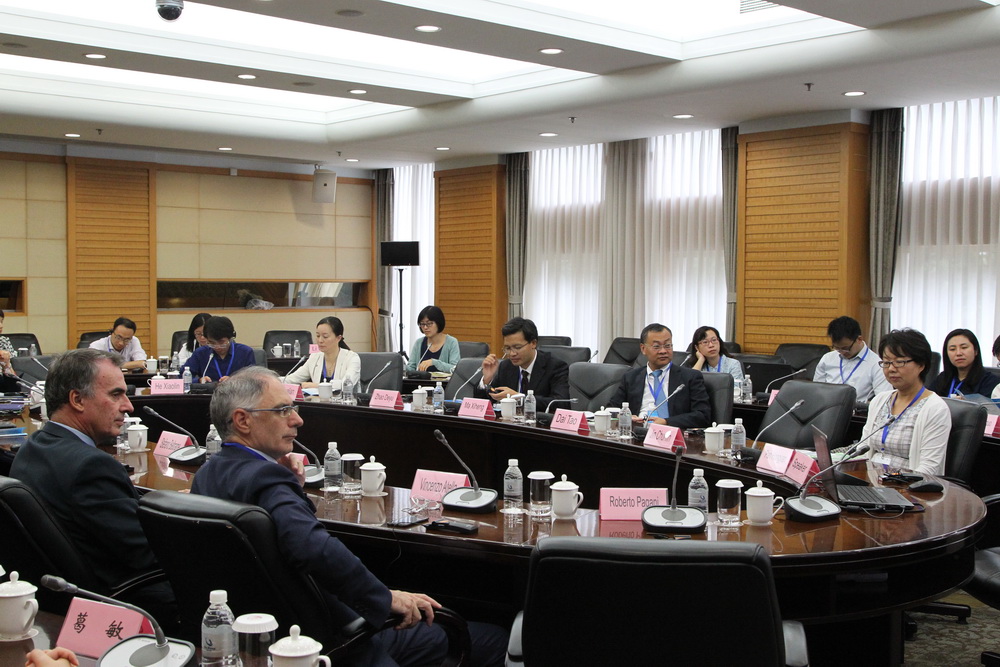
At the seminar, Prof. Vincenzo Atella, Director of the Italian Centre for Economic and International Studies (CEIS) and Prof. Carlo Caltagirone, Director of the Scientific Institute for Hospitalization and Healthcare of the “Fondazione Santa Lucia” of Rome, introduced “Urban Healthcare of Rome: Challenges and Status quo of Smart Cities” and “Italian Network of the Research Hospitals: An Experiment Lasting Eight Decades”. Deputy Director of Putuo District Human Resources and Social Security Bureau YIN Hualian, Director of Xuhui District Civil Affairs Bureau SHI Tao and Director of Changning District Health and Family Planning Commission GE Min made themed speeches respectively on Shanghai’s exploration and practice of the long-term healthcare guarantee system and the family doctor system. Prof. ZHAO Deyu from School of Social Development and Public Policy of Fudan University and Prof. JIN Chunlin from Shanghai Research Center for Sanitation and Health made academic speeches respectively on the Network Analysis of Health Self-management Group of Community Resident in Shanghai and the Financial Support System and Sustainability of Basic Public Health Services in Shanghai.




 Shanghai public network filing 3101042008844.