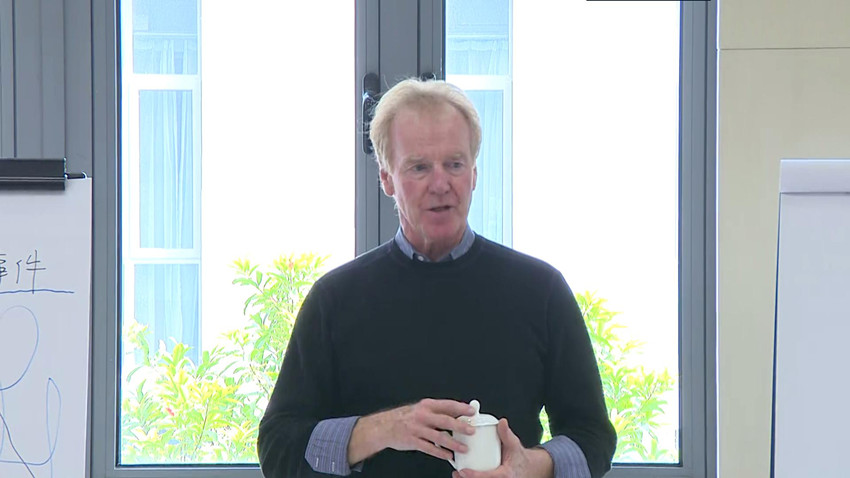
On July 4, Professor Peter Senge, a world-known master of management and founder of learning organizations theory, passed on modern training concepts to the first core teachers class of Shanghai Party Schools in a lecture themed Theories and Instruments for the Improvement of Mental Modes. “Improving Mental Modes” is one of the five disciplines in Peter Sedge’s theory on learning organization. The discipline reveals the psychological laws in the realization of innovation. It values deep reflections and active improvement of stereotyped mental modes of individuals and organizations so as to seek innovation.
Peter Senge gave the lecture in the teaching style of reflection and guided the students to successively practice the three instruments for the improvement of mental modes---- “Iceberg Model”, “Deduction Ladder” and “Systems Archetype”. His lecture consisted of five parts: students sharing cases, students using the instruments to analyze the cases, teacher introducing the theories behind the instruments, students reflecting the analyzing process and sharing their understandings, and teacher commenting and summarizing. This teaching style had three features:
Firstly, it fostered students’ aspiration. Peter Senge said that learning organization required students to learn spontaneously and creatively while in usual cases teachers spent a lot of time on lesson preparations but paid little attention to helping students prepare for learning. He suggested that teachers should not provide ready answers but should understand and inspire students’ interest in learning as well as fostering their eagerness for answers.
Secondly, it held the view that students were the leading part of learning. Peter Senge believed that “reflection” was the essence of learning, which required students to be truly the leading part of learning. In the lecture, Peter Senge fully demonstrated the practice of this theory by transforming the complex mental modes theory into a number of thinking instruments. Through practice, reflections, and idea sharing, the students had a deep understanding of the theory.
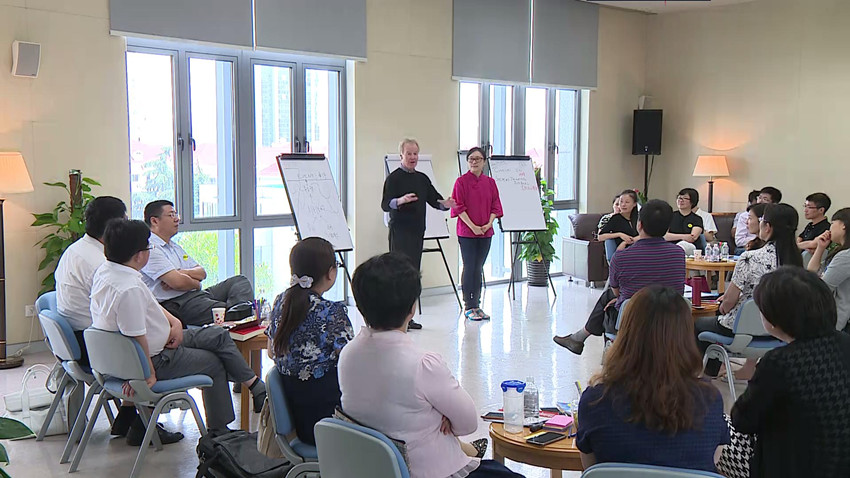
Thirdly, it built an open learning environment. Peter Senge emphasized that the learning environment was very important for students to become open. When the students entered the classroom, they didn’t see desks, platforms or projectors. Instead, they saw island-style chair clusters, green vegetation, floor lamps, and several pieces of white board. Without the barrier of platforms and desks, the interaction became smoother.
The one-day class left the students with plenty of inspirations and lingering around thinking. One of students thought that Peter Senge enabled them to understand that reflection was the essence of learning and that the leading status of students in learning should be embodied in the interactions between teachers and students, and between students and students. Another student said that the mental mode theory saw some similarities in Confucianism and that we should be confident to apply this kind of teaching theory into the Party school theories and the education of Party character. Many students were touched by the fact that SPI invited the world-famous masters and introduced the most advanced teaching theories in teaching. They thought that it fully showed SPI’s concern and expectation for the teachers in the Party school system.
This teaching practice was a beneficial attempt of SPI’s reinforcement in fostering of core teachers in the Party school system and teaching innovation, which opened a new window for the innovation of theoretical teaching in Party schools.
Peter Senge is an experienced professor at MIT Sloan School of Management as well as Founder and Chairman of the Society for Organizational Learning. His representative works include The Fifth Discipline: The Art and Practice of the Learning Organization, The Fifth Discipline Fieldbook, The Dance of Change, and Schools that Learn. They have triggered a worldwide management trend for creating learning organizations.


 Shanghai public network filing 3101042008844.