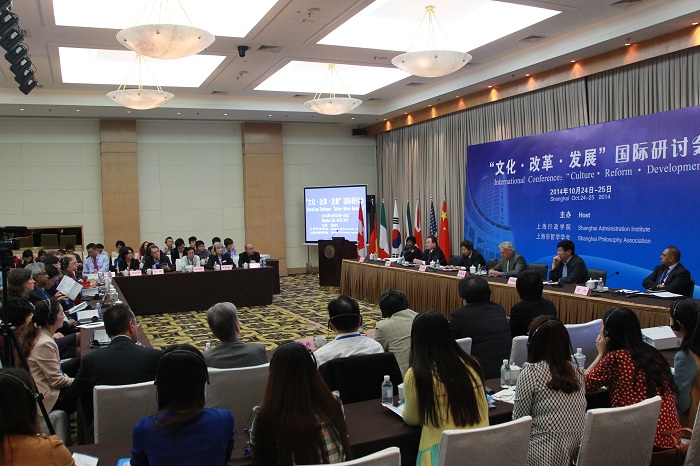
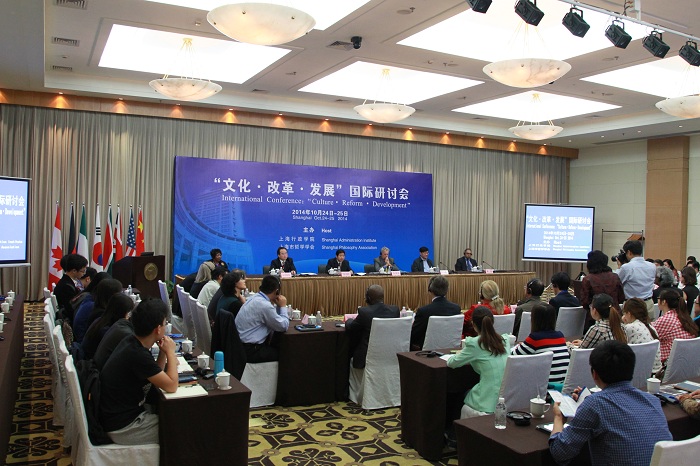
From October 24 to 25, the International Symposium on “Culture, Reform and Development”, co-sponsored by Shanghai Administration Institute and Shanghai Philosophy Society, was held at the institute. WANG Guoping, executive vice-president of the institute, and Alan Hudson, winner of the Shanghai Magnoglia Award and director of Oxford University’s Leadership Programmes for China, attended and addressed the opening ceremony as hosted by GUO Qingsong, vice-president of the institute.
The attendees had academic exchanges on such theoretical and practical issues as “Cultural Values and Development Philosophies”, “Globalization and Cultural Diversity”, “Protection of Cultural Heritages and Traditional Culture”, “Development of Cultural and Creative Industries” and “Influences of Internet and Digitalization on Culture and Countermeasures”.
The symposium believes that culture is the blood vessel of a nation and needs to be developed and accumulated over centuries, rather than at one stroke. Though challenged with the changing times and by new things and thoughts, the inheritance and development of culture observes the same principle. Culture is both ethnic and universal. Economic globalization has accelerated cultural transmission and integration around the globe. Cultures are diversified through exchanges and enriched by drawing merits from each other. Experts attending the symposium have reached consensus on the following topics. Firstly, the importance and power of culture should be fully recognized; secondly, the duality of modern civilization should be recognized and researched; thirdly, cultural development should be based on good relations between multi-culture and native culture and between traditional culture and modern culture; and fourthly, humanism education should be highlighted during the cultural development.
The symposium was attended by more than 20 foreign scholars and officials from the USA, the UK, Canada, Italy, South Africa, Republic of Korea and other countries, and more than 80 Chinese experts and scholars from over ten universities and research institutes, including Fudan University, East China Normal University, Shanghai Jiao Tong University, Shanghai Academy of Social Sciences and Southeast University.


 |
|
 中文版
中文版