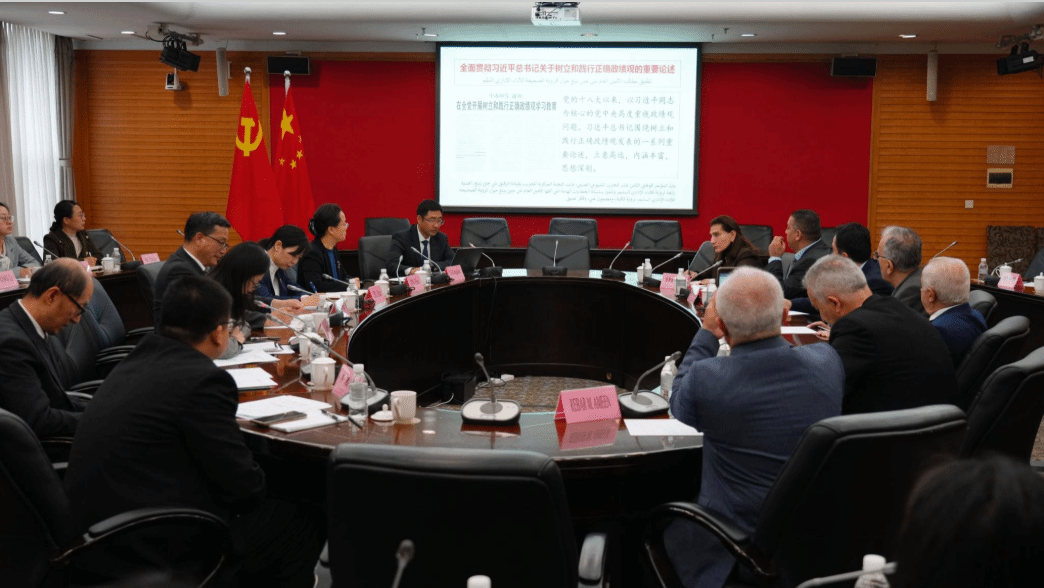
On April 14, a delegation led by Kawa Mahmoud, Chairman of the Global Civilization Initiative Research Center of Iraq, visited Shanghai Administration Institute(SAI). The delegation consisted of political party representatives and scholars from think tanks and universities in Iraq, Palestine, Syria, Jordan, Lebanon, and other countries. Wang Yongjie, Vice President of SAI, presided over the meeting.
Wang Yongjie extended a warm welcome to the delegation. He reviewed the academic exchanges between SAI and the countries represented in recent years, and gave a focused introduction to the integrated development of teaching, research, and consulting, as well as international cooperation and exchanges. Wang noted that since General Secretary Xi Jinping proposed the Global Civilization Initiative, it has received enthusiastic responses from the international community. He expressed pleasure at seeing the Communist Party of Kurdistan in Iraq take the lead in establishing the Global Civilization Initiative Research Center, with active participation from political party representatives and scholars from think tanks and universities across the Middle East. He stated that SAI is willing to work with the center to build a platform for cross-cultural exchange and to continuously deepen civilizational exchanges between Shanghai and Middle Eastern countries. He also expressed hope that, taking this visit as an opportunity, both sides would leverage their respective strengths to enhance exchanges and cooperation, and promote mutual learning among diverse cultures.
Kawa expressed his gratitude for the SAI’s warm reception. He introduced the functional positioning of the Global Civilization Initiative Research Center of Iraq, noting that this exchange provides valuable reference for the education and training of cadres from left-wing political parties—especially communist parties—in Middle Eastern countries. He expressed hope to further strengthen exchanges and cooperation in areas such as political party governance, capacity building for governance, and training of party cadres.
Professor Li Zongjian, Director of Department of Leadership Science, gave a special presentation on the significance, scientific connotation, and practical requirements of establishing and practicing a correct view of political performance. The visiting participants engaged in lively discussions, conducting in-depth exchanges on topics including China’s current stage of development, the Communist Party of China’s ideological guidance for youth, the implementation of democratic centralism, and how to uphold ideological security in academic research.


 |
|
 中文版
中文版